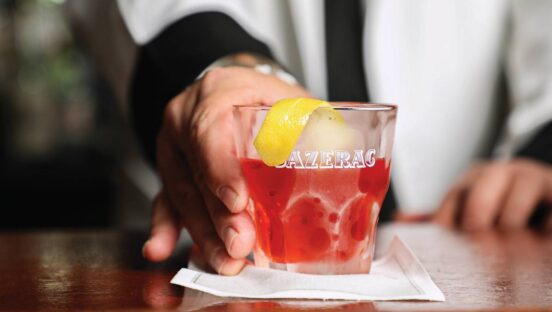
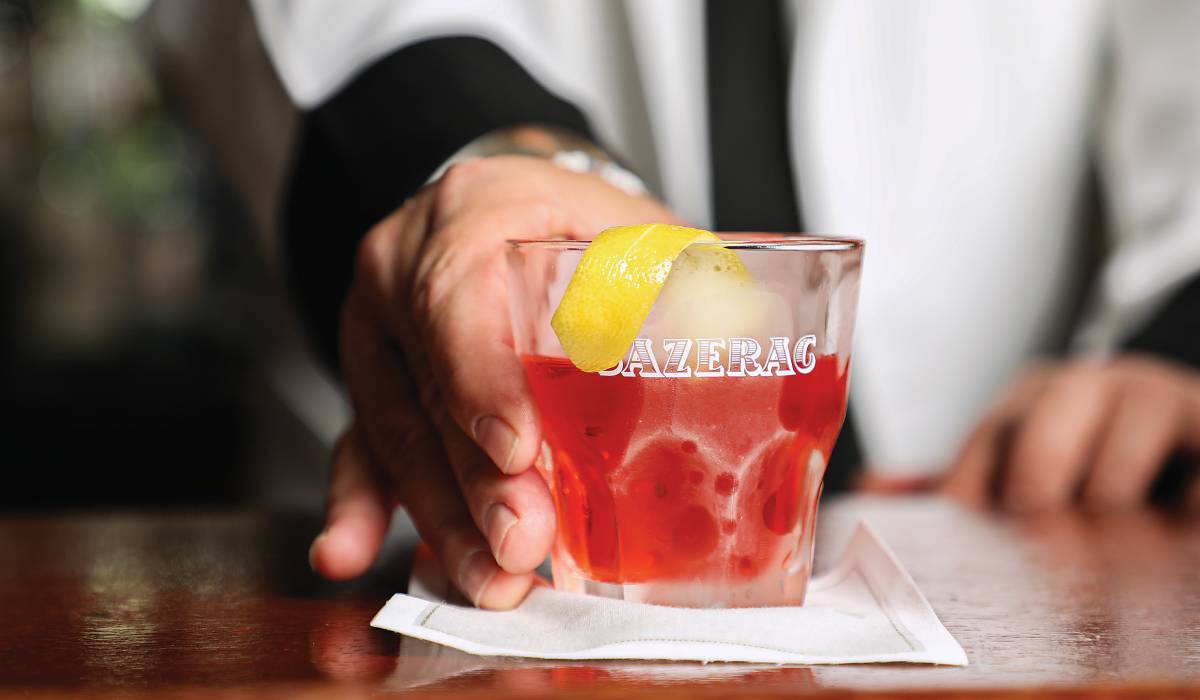
At the Sazerac Bar at The Roosevelt New Orleans, history isn’t tucked behind glass. It lives in the African walnut bar, the Art Deco murals, the silver pieces behind the bar—and, every night, in the rye, sugar, Peychaud’s bitters, absinthe rinse, and lemon oil that make up its namesake cocktail.
The Sazerac isn’t simply a drink that shares the bar’s name. Its roots reach back to the Sazerac Coffee House, where, in the 1850s, bar owner Aaron Bird began importing Sazerac-de-Forge et Fils cognac and pairing it with Peychaud’s bitters. The original coffee house eventually closed, but the Sazerac Bar opened at The Roosevelt in 1938, cementing the cocktail’s connection to the hotel and the city’s larger drinking culture.
For many guests, having a Sazerac at the Sazerac Bar is “almost like a pilgrimage,” says Matt Schulte, assistant food and beverage director at The Roosevelt New Orleans.
“What I love is that after all these years, the drink itself remains remarkably simple,” he says. “There aren’t many places for a bartender to hide. Technique matters.”
That kind of history can carry a lot of weight, he adds, but the bar isn’t frozen in time.
“We’re not a museum,” Schulte says, noting that the philosophy behind the program is “to honor our history without being trapped by it.”
That tension—between honoring a legacy and steering a business into the future—is a familiar dynamic for operators across New Orleans, a city with no shortage of long-running bars and restaurants.
Take Tujague’s. Founded in 1856 in the French Quarter, it is New Orleans’ second-oldest restaurant and the country’s third-oldest continuously operating restaurant, according to Mark Latter, founder and CEO of Latter Hospitality. Latter took over Tujague’s in 2013, after his father and uncle had operated the historic restaurant since 1982.
The restaurant is home to the Grasshopper, a sweet, mint-and-chocolate after-dinner cocktail made with green crème de menthe, white crème de cacao, and heavy cream. The drink was introduced in 1918 by Philip Guichet, part of the family that owned the restaurant at the time, after a cocktail competition in New York.
“It’s still our leading-selling cocktail, which is surprising because it has a lot of cream and it’s a little heavier,” Latter says.
For Tujague’s 170th anniversary this year, the restaurant is offering mini Grasshoppers for $1.70, giving first timers an easy entry point to the drink and its history. The team has also explored Grasshopper-inspired desserts, including pie, panna cotta, and cheesecake.
Still, Tujague’s is a restaurant, not a nostalgia project. Its broader beverage program is built largely around small variations on familiar drinks, with an eye toward cocktails that work alongside dinner.
“Whether it’s the food menu or the cocktail menu, we try to do a riff on classics,” Latter says. Its Iris 75, for instance, builds on the French 75 with purple Empress Gin. It’s a nod to the restaurant’s Krewe of Iris room, which honors the city’s oldest all-female Mardi Gras parade.
At the Sazerac Bar, that line is drawn by recognizing which classics are better left alone. The Sazerac and Ramos Gin Fizz do not need an overhaul, Schulte says. Part of their appeal is experiencing them much as previous generations did.
“When a classic is already extraordinary, we leave it alone and focus on executing it exceptionally well,” he says. “When we see an opportunity to take the DNA of a classic and tell a new story with it, that’s where our signatures come in.”
For those signatures, Schulte says, creativity needs context. A drink might reference a historic recipe, a local ingredient, New Orleans history, or a recognizable thread from classic cocktail culture.
“We’re not trying to put something on the menu just because it’s trendy or because nobody has done it before,” he says. “We actually like the idea that somebody has done it before, and we’re carrying their idea forward in our own way.”
That gives the bar room to serve a Ramos Gin Fizz alongside signatures like the Butterfly Effect. The latter combines Mijenta Reposado Tequila, mezcal, Calpico, hibiscus, lemon and rosemary, with an edible Electricdust butterfly that adds a tingling sensation across the palate. Taken together, Schulte says, those drinks reveal the two sides of the program.
“One lets our guests experience the history of New Orleans cocktail culture,” he says, “The other gives them a glimpse of where it can go next.”
Both operators are seeing familiar trends across the broader beverage landscape: less emphasis on wine, growing demand for tequila and agave spirits, and cocktails designed for a social-media moment or some other experiential element.
At the Sazerac Bar, though, Schulte says the most consequential shift is that guests increasingly arrive with knowledge of specific producers, additive-free tequila, single-barrel whiskey, amaros, and other niche categories—and a greater interest in understanding what is in the glass.
At the same time, he thinks the industry is moving away from complexity for its own sake, with the pendulum swinging back toward “simplicity, quality, and intentionality.”
Latter agrees but is quick to point out that this doesn’t mean historic programs can stand still. “Your menu has to constantly evolve,” he says. “All the historic restaurants in New Orleans have done this.”
For Schulte, that starts with knowing the history. From there, he says, protect the things that actually matter—the recipes, rituals, craftsmanship, service standards, and stories—“but don’t confuse tradition with refusing to change.”
After all, the people who created the bars and cocktails now treated as untouchable weren’t trying to make history. “They were trying to create something people enjoyed,” Schulte says. “That’s still our job.”