Chili’s same-store sales have gained a collective 50 percent over the past three years. So, CMO and EVP George Felix wasn’t dealing in hyperbole when he told investors recently the brand had been “pretty busy.”
What Chili’s was up to boils down to a few investment-laden storylines. The company spent $100 million-plus in facilities. It reworked hospitality by pouring back into labor. Chili’s refocused on core execution and menu architecture.
But when talking about one of the most-vivid turnarounds in category history, people often start with how loud the brand became.
Chili’s in that opening calendar under Felix and CEO Kevin Hochmann—who worked together at Yum! Brands—spent about $32 million in marketing. Three years later, the figure was closer to $132 million.
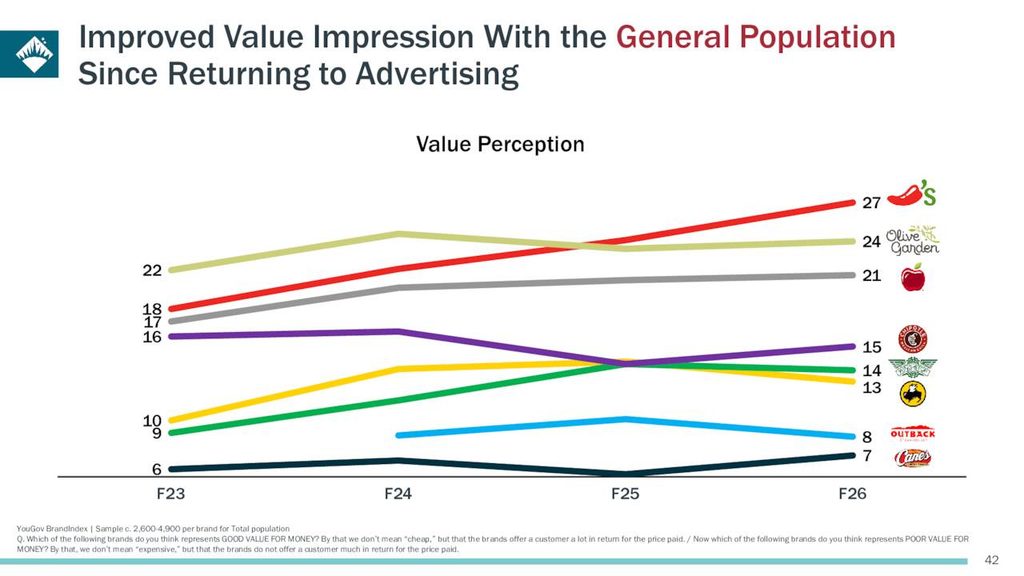
Felix during Brinker’s investor day dove deeper into what’s been the most outward effect of that higher backing: value perception. This chart below, which uses YouGov data, lays out value perception scores among the general population of adults 18–49. Since rerouting, Chili’s result increased by 50 percent, placing it atop the company’s competitive set, widely speaking.
However, Felix said, what’s more interesting is the following, which unpacks how value perception turned among customers who saw the brand’s advertising in the past two weeks. Trends were similar. There, too, Chili’s witnessed a sizable increase over the past three years. And again, it topped the competitive field.
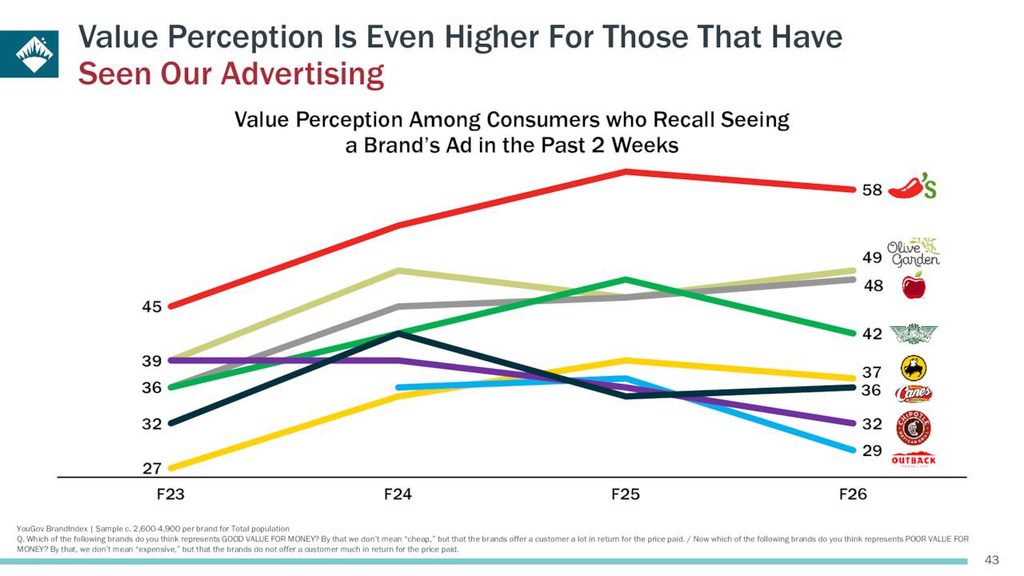
“But you can see that the increase in value perception is much bigger and the gap between us and competition is much wider,” Felix explained.
What that tells Felix, he continued, is Chili’s “Better Than Fast Food” campaign continues to resonate. When customers find the messaging, it’s making them think differently about the value Chili’s offers.
What gives Chili’s confidence there’s still room to go?
“Well,” Felix said, “when you think about ad awareness and the way to think about ad awareness is that is basically asking consumers, ‘have you seen a brand’s advertising in the past two weeks?’”
MORE:
Chili’s Turnaround Clears Way for New Restaurant Growth
How Chili’s Plans to Remain ‘America’s Hottest Restaurant Brand’
For Chili’s, that particular measure hiked roughly 40 percent over the last three years. You’d expect it to, Felix said, when you toss $100 million into the mix.
However, Chili’s, even with such a vivid bump, still trails the largest spenders in its category. “And so that tells me that there are still probably large pieces of the population that have not seen or been exposed to the ‘Better Than Fast Food’ campaign,” Felix said. “And if you look at the last chart, you know that once we do get people to see that, it does change the way that they think about Chili’s.”
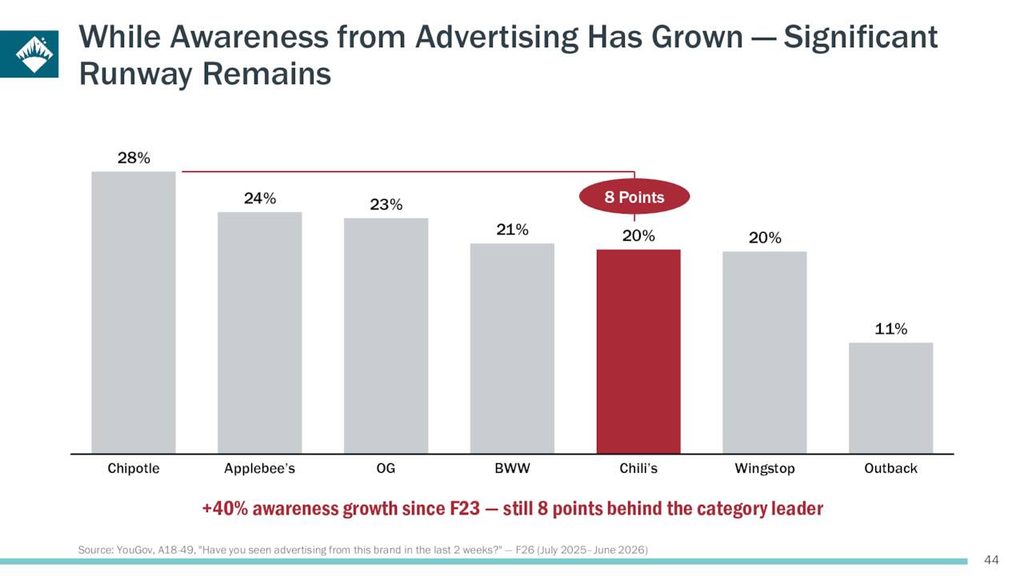
In plain terms, Chili’s marketing hook has been to reintroduce guests to a brand they might have lapsed on. How they feel about it. What it offers compared to competitors. And then, invest via operations in an experience and environment worth coming back to.
That education process, Felix said, remains underway.
There’s also the familiar question marketers face—how have holistic metrics translated to sales?
Felix pulled up a slide on Chili’s “Five to Drive” categories. Years ago, in 2017, Chili’s slashed 50 menu items and started to refocus on core products. Its offerings had ballooned to 125 items (40 percent cut). That work continued when Hochman arrived, with about 60 percent of the menu getting renovated. Chili’s sliced more than 25 percent of overall items and moved, as Felix said, to what the brand was known for: burgers, crispers, fajitas, margaritas, and now, the Triple Dipper. Meanwhile, Chili’s devised a heavy labor approach where, when 2026 rolled around, the company was investing $160 million more than it did in fiscal 2022.
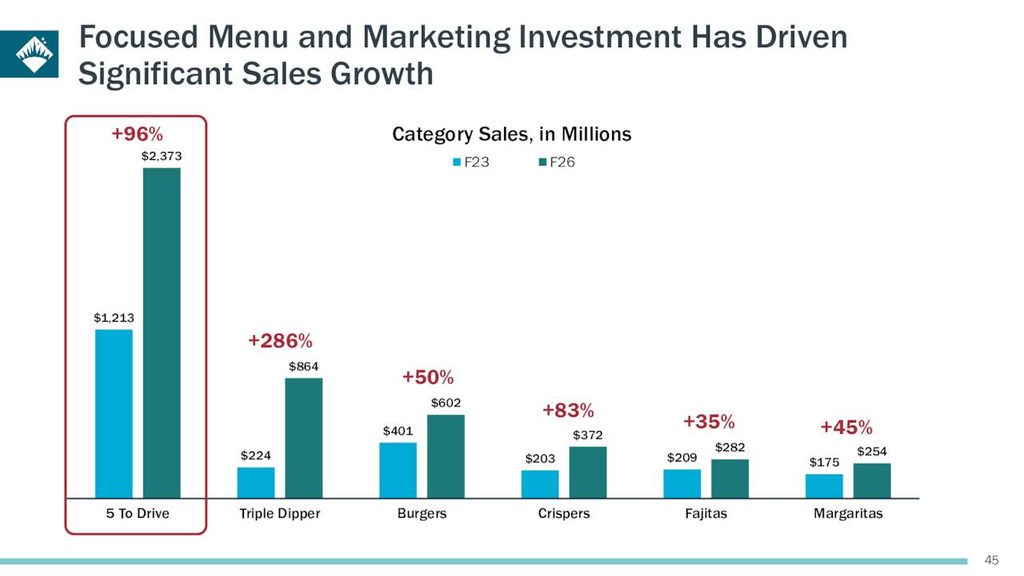
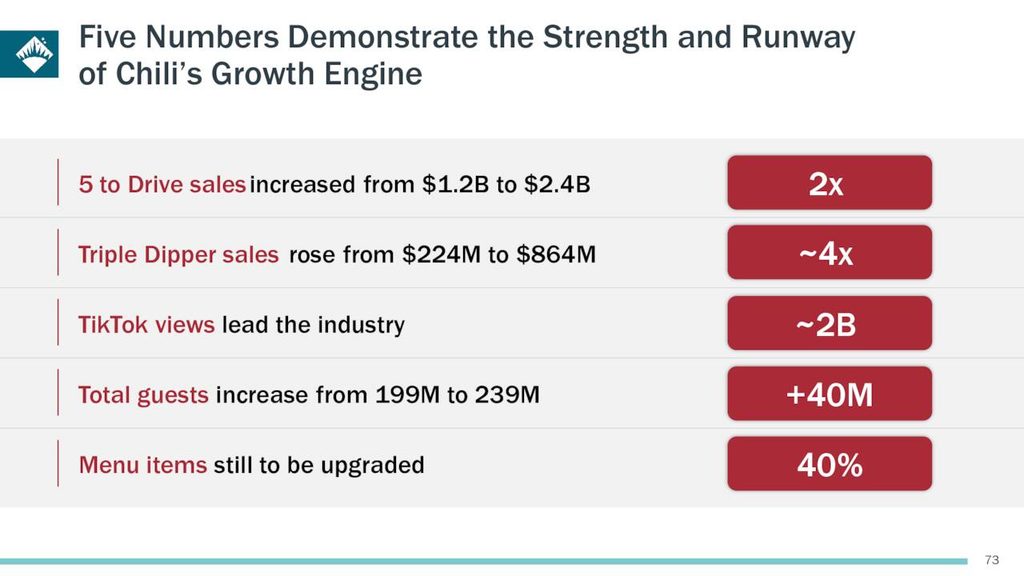
Chili’s Five to Drive categories have nearly doubled in sales over this 36-month window and the Triple Dipper is up about 300 percent. “So, what we have is a proven marketing model,” Felix said. “And the next phase is about doubling down on it.”
Felix said Chili’s is going to give guests more reasons to visit. It’s going to be more relevant in culture, and it’s going to bring more guests into restaurants.
How starts with industry-leading traffic and, once more, category-fronting value. Traffic for Chili’s climbed 1.5 percent in Q4 on top of 16.4 percent for a two-year view of 17.8 percent. Traffic surged 19.6 percent over the past two full fiscal calendars.
Chili’s has posted five consecutive years of same-store sales gains (up 70 percent) and average-unit volumes have tacked on $2 million per restaurant to stretch from $3 million to $5 million. AUV sloped from $4.5 million to $5 million in just the past year or so.
If there’s one query Felix fields often, when it comes to if the brand can sustain, it’s what happens if/when Chili’s gets undercut on its 3 For Me at $10.99? What if peers introduce lower price points? Will that dampen Chili’s sentiment?
On that note, Felix said, he has some good news. It’s not a matter of if anymore. “We already know the answer because literally every single brand across fast food, fast casual, and casual dining have done this,” he said. “You see $1, $3, $5, $9.99 in casual dining. It hasn’t slowed Chil’s down. And the reason is that at Chili’s we believe that true value is more than a price point. It’s the holistic experience of what you get for what you pay.”
The consumer today is a wary one, Felix said. That’s not exactly a recent development and likely won’t be in the rearview any time soon, either. Gas prices are high. Maco challenges and political questions will define the latter frame of 2026. But in shaky times, he said, customers don’t abandon brands. Rather, they search for places they trust and can rely on.
Chili’s has three promises it makes every day, Felix said. One is everyday price certainty. Chili’s refers to this as “EDLP,” or a everyday low price point. That’s also a three-pronged approach. Customers have that reliable number, meaning they know what they can pay and don’t need a coupon or happy hour or early bird to get it. There’s no tapping an app for a special offer.
Guests understand any Chili’s, any day, will offer a $10.99 meal and a $6 margarita. It’s a tier, Hochman added at investor day, showing up $3–$4 less on a per person average than the chain’s casual-dining competitors.
Additionally, diners get more for their money. “We’re trying to figure out how do we continue to deliver more for the guest, whether it’s better ingredients, whether it’s bigger portions, whether it’s better service. How do we give the guest more while we have a price value advantage?” Hochman said.
Chili’s burgers in the $10.99 deal are nearly half-pound products.
“If you compare them to what you get in the drive-thru,” Felix noted, “it really puts fast food to shame.”
Another point, Felix added, concerns how Chili’s could possibly make money with these varied price points. Hochman said look at the demographics. One truth about casual dining is it’s likely the only retail concept or trade channel that welcomes all walks of life across the country. If you examine wide-ranging data and look at Chili’s and the casual category’s profile by large, they aren’t all that different.
Meaning, the key for Chili’s is to meet everybody’s needs. “Not every customer wants a $6 margarita with good tequila,” Hochman said. “Some customers want the most premium tequila. Some customers want steak or ribs, right? So, as long as we’re meeting all consumers’ needs, we’re able to make the margins work.”
The value of execution
Felix said you can’t understate the role creating a “fun, consistent, reliable experience” in a “fun atmosphere” plays into how customers perceive the “worth” of a restaurant visit.
Chili’s refers to it as “Chili-head hospitality.”
“That’s a smiling face greeting you at the front door, opening the door for you. That’s our amazing servers taking care of you from the minute you sit down to the minute you leave. All done in a fun and vibrant atmosphere,” Felix said. “… You’ll never see our team members point you to a kiosk, have you put an order in on a screen or talk to an AI drive-thru that doesn’t understand what you’re saying.”
Chili’s “Better Than Fast Food Campaign” doesn’t begin and halt at the dollar sign; it’s something the brand hopes diners feel at multiple touchpoints that simply don’t exist in counter service.
Chili’s, as its recent chicken sandwich update backs, also still believes it can upgrade what’s showing up on the plate, from protein to salads to kids meals to beverages.
Felix said Chili’s appreciates a playbook now it’s run “over and over again,” just like it did with the 60 percent overhaul mentioned before. Step No. 1 is elevating an offering. The brand picks a category it, looks at individual aspects worth fixing, and figures where Chili’s can deliver a better experience and value for diners.
Afterward, the chain turns it over to the creative team to decipher how to bring it to life. Sometimes, Felix said, it takes the form big TV advertising, like 3 For Me. Other instances, Chili’s might do a culture pop where it talks about the Margarita of the Month. Conversely, Chili’s could focus in-restaurant with menu and merchandising, as it does with classics like ribs and fajitas.
“When we do those first two things well,” Felix said, “we know we drive sales and traffic, and we can create larger categories that are more profitable.”
Felix elaborated on how Chili’s accomplishes this across F&B. The brand is the leading seller of margaritas in the U.S. It poured 30 million in 2025.
Like Hochman explained, you can’t do that without meeting the needs of all margarita drinkers. Chili’s covers value with $6 monthly offerings and then offers premium options, such as a Don Julio Margarita for roughly $12.
But Chili’s insights team uncovered another gap in the middle, Felix said. It surveyed Chili’s margarita lovers and discovered more than half preferred a frozen option. Going back about two years, Chili’s had 12 rocks margaritas and one frozen.
In turn, it set out to create a better frozen version and launched a Patrón Frozen lineup a little over a year ago, starting at $10. “It’s been a huge hit,” Felix said.
One in four margaritas sold at Chili’s today are of the frozen variety.
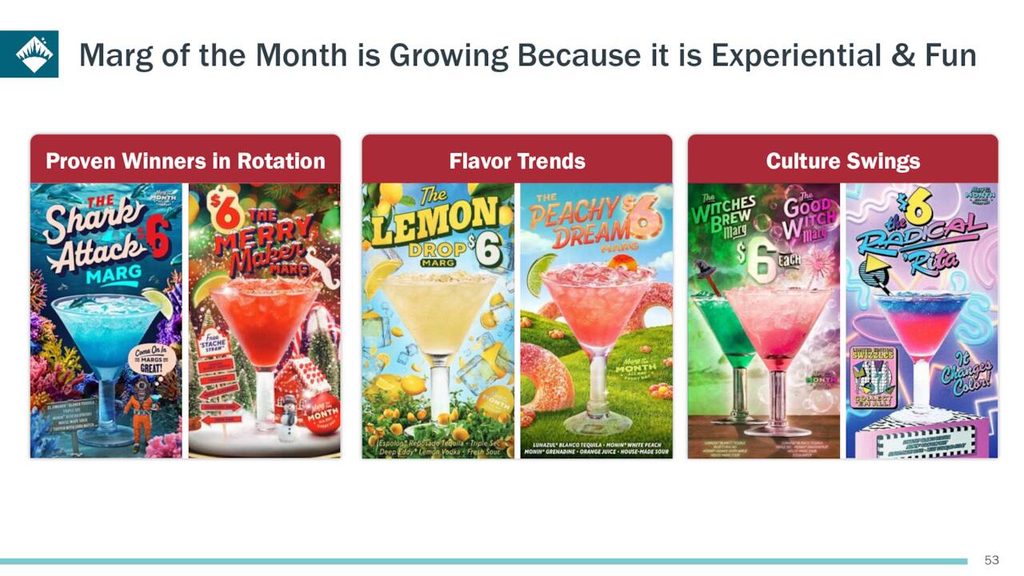
And with its Margarita of the Month program, the brand codified how to keep it fresh. There’s a stable of proven options customers look forward to returning, helping with alcohol attachment. Also, Chili’s keeps innovating around trending flavors.
That boosts check while also giving Chili’s another lane to be relevant. Some big sellers last year included a Peachy Dream Marg and Lemon Drop.
Additionally, a few times per year, Chili’s take a bigger swing and inserts itself into the cultural conversation. Say, last November’s Witches Margaritas, which were green or pink and played alongside Wicked. “It went crazy on social media,” Felix said.
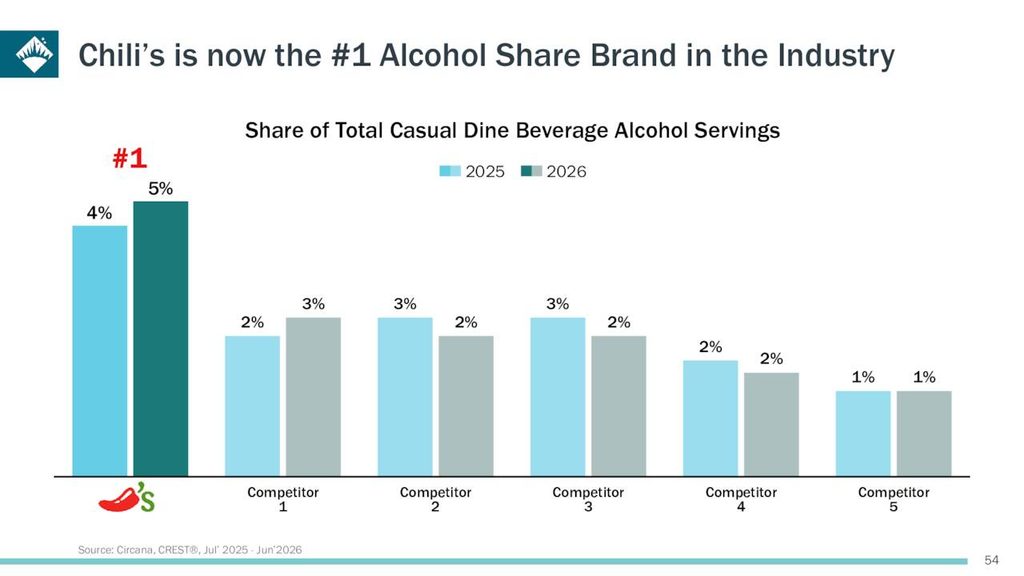
Chili’s saw not only the largest Margarita of the Month sales in company history, but also a noticeable traffic lift. “We know that the alcohol category has had some challenges in the last few years with fewer people opting into alcohol,” Felix said. “Amidst that backdrop, Chili’s has been one of the few brands that’s actually been able to grow share in the alcohol space all the way to the point where we are now the No. 1 alcohol share brand in the entire industry.”
Turning to food, Felix hinted there’s a strong pipeline over the next two years. Chili’s recently combined two fan favorites to launch a “Chicken Parm Big Crispy” sandwich that’s a spin on the standard. It puts fried mozzarella on top of the new sandwich with marinara sauce.
More widely, since introducing Big Crispy chicken earlier in the year with six different variations, orders in the category soared 175 percent.
Salads are going to come under the microscope as well. Felix said salads represent a vital cog at Chili’s since they satisfy the veto vote. The brand wants to elevate them so it’s not falling behind.
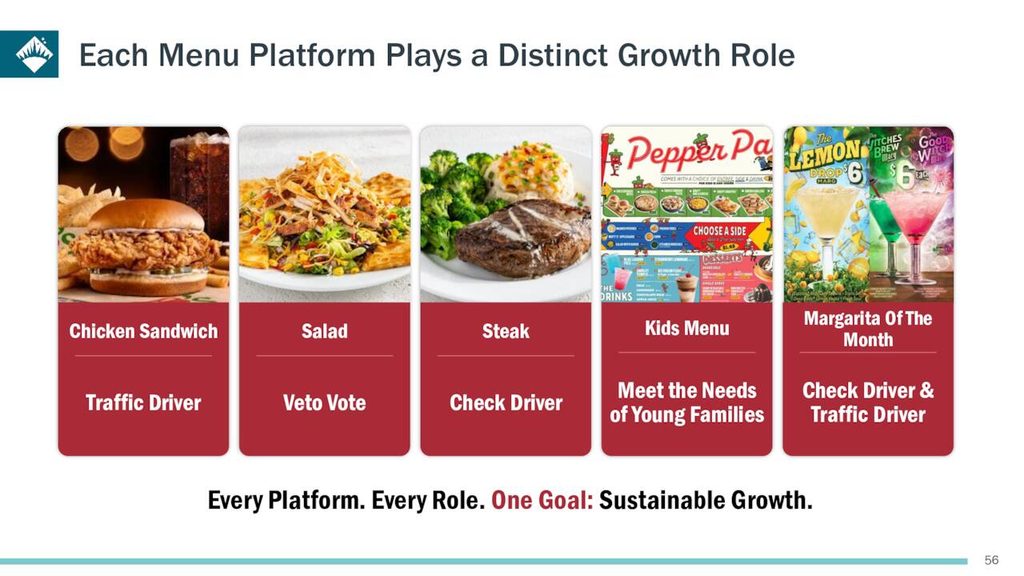
It’s going to rethink the bowls salads show up in, the lettuce blend, and variety. It’s also going to make sure as proteins upgrade across the menu, customers have the chance to mix and match across every salad.
Kids menus added ice cream floats (Coca-Cola and Dr. Pepper paired with new Blue Bell Ice Cream) and Chili’s updated the creative. The actual kids menu display hadn’t been rethought in more than a decade.
Now, it reflects Chili’s modern brand and gives kids activities for their stay.
More upgrades, more buzz
Going forward, how will Chili’s materialize so many changes? Felix said it comes back to the start. The brand saw all over social media how consumers were “absolutely fed up” with the rising cost of fast food. “They’d make videos, holding up receipts, saying, ‘how did I spend this much money in the drive-thru?’” he recalled.
As Chili’s dug in, it realized the prices of QSR had climbed into Chili’s sphere. Yet the brand offered, in its view, higher quality food, more abundant portions, and an experience you couldn’t get driving through a lane.
The “Better Than Fast Food” campaign began in 2024 with The Big Smasher, which, for all intents and purposes, was a mirrored Big Mac, but with twice the beef.
“Business took off and it hasn’t looked back,” Felix said.
In 2025, Chili’s followed with a Big QP (naturally, an answer to the Quarter Pounder with cheese, only with 85 percent more beef). Then, in April, the Big Crispy arrived to sit alongside fast food’s plethora of chicken sandwiches.
“That is us saying Chili’s is now a player in the chicken sandwich market and that we were telling America that they deserve better than tiny overpriced fast food chicken sandwiches,” Felix said. “And the Big Crispy absolutely dwarfs anything you’ll find in the drive-thru.”
Felix said the momentum and results of Chili’s “Better Than Fast Food” positioning has been solid, but there’s whitespace to chase. It’s gone after the top QSR category in burgers and, as noted, recently slid into chicken. What’s next? Felix said there’s a lot to pick from.
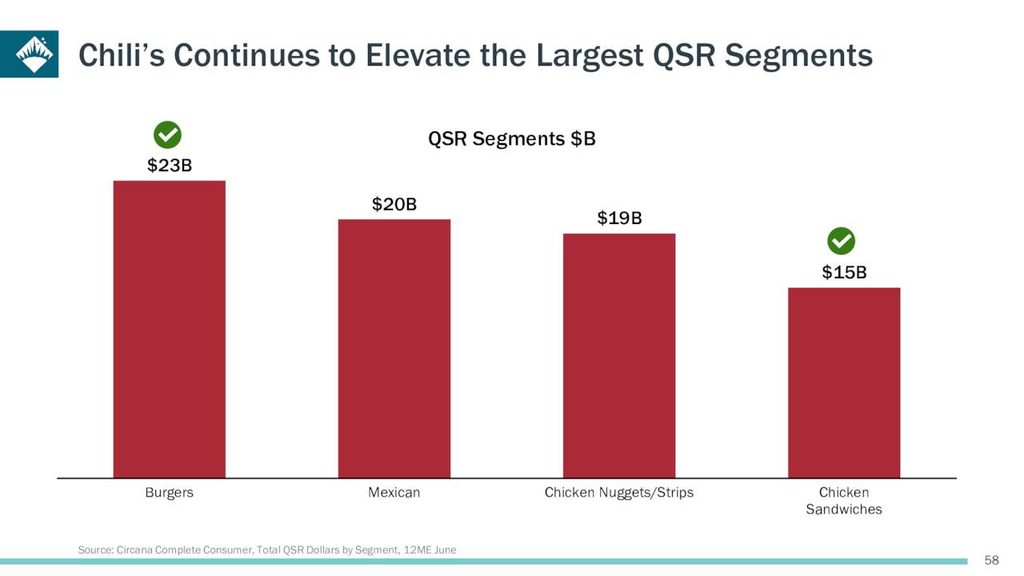
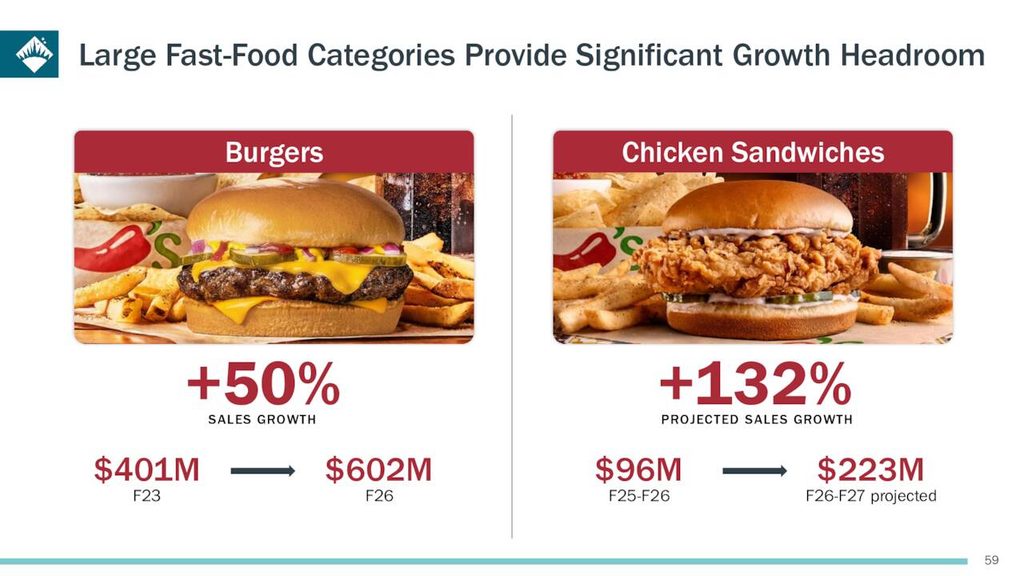
Burgers, for instance, were already a massive category for Chili’s, at $400 million It’s grown 50 percent since the campaign ignited and today resides north of $600 million.
When Chili’s had a lone chicken sandwich, it was about a $96 million segment. Annualizing what’s taken shape thus far, Chili’s projects Big Crispy to become a $220 million category.
Circled, though, is Mexican QSR. “Why wouldn’t Chili’s, who has a right to win in this category, take that category on next?” Felix said.
That doesn’t mean it’s going to happen tomorrow. Felix said Chili’s won’t get there in the next few months or even a year. It’s likely a two-year project.
However, what he’s trying to get across is Chili’s hasn’t bumped the ceiling yet with its campaign against the perceived (or sagging) value of fast food. “We have a huge pipeline ahead of us of things we can do,” Felix said.
With Mexican, Chili’s already plays in categories like quesadillas and fajitas. The former, as an example, has a hero item in the Chicken Bacon Ranch. But as Chili’s continues upgrading proteins, like fajita steak, it can find other places to elevate. That is headed to salads. It can also go to quesadillas.
And considering tacos, where Chili’s Chicken Crispers are a sizable offering, the brand can deliver in a familiar format. So, a Chili’s turn on tacos using Chicken Crispers. They might come in a base variety. Or, spicy with a new mayo that was added for Big Crispy. Chili’s can do sauced such as its cult-favorite Honey Chipotle.
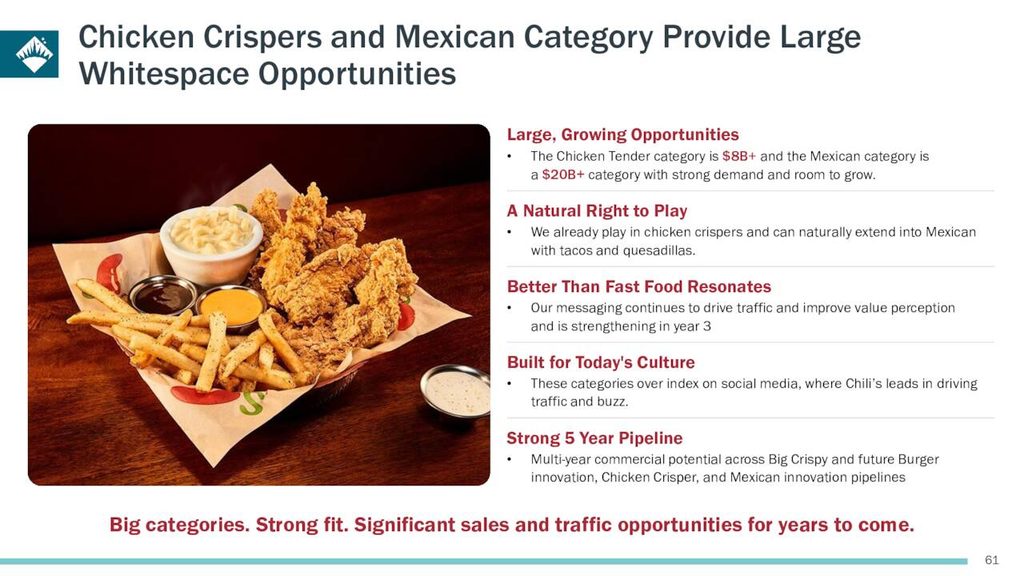
“When you think about where we can go with the Better Than Fast Food Campaign, what I want you to hear is we have years of runway ahead of us,” Felix said. Chicken sandwiches alone have two years of strip to become a destination in of themselves.
“We know we can keep innovating on the burger category. Our Chicken Crisper business has doubled in the last three years without any advertising just through menu merchandising and upgrading the product,” Felix said. “And then, if you throw Mexican in, in a couple of years, I can easily see five years of a pipeline of where we can go to keep the Beter Than Fast Food campaign going strong.”
A marketing playbook—not just marketing wins
Here’s something else Felix regularly hears: Chili’s got lucky with the now-viral cheese pull. “I take some personal offense to that,” he said of the 2024 TikTok that crossed 4 million views.
Felix explained Chili’s intentionally developed a capability where it repeatedly can insert the brand into culture debates. When it does so, it drives buzz, consideration, and purchase.
As shown, culture pops are a regular topic for Chili’s. There’s was a Lifetime movie; Triple Dipper Halloween costume; Lizzo remaking the company’s famed jingle.
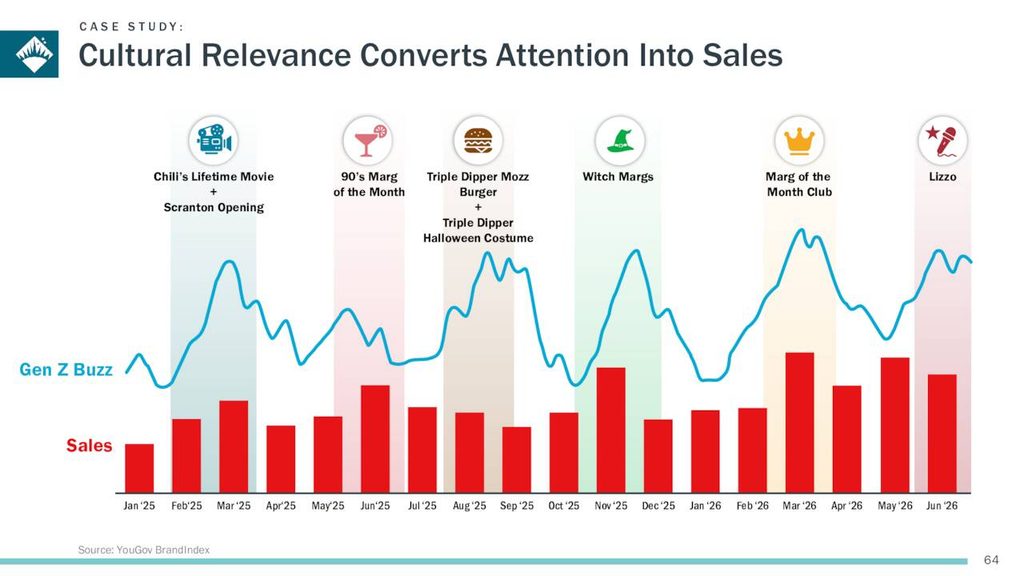
Chili’s has shown, when it inspires chatter among Gen Z, they start thinking about coming to restaurants. They’re showing up and operations teams and employees are delivering an experience above expectations.
“If we go to the triple dipper, a lot of food brands have viral moments,” Felix said. “The difference between when most brands have a viral moment and what we’ve done at Chili’s is that ours is sustained.”
“Most brands have a viral moment and their sales spike for one to three weeks, then their business normalizes again and everything kind of goes back to normal,” he continued. “For us, when we saw the viral moment happening with the cheese pull and the Triple Dipper, we mobilized our social media team and our innovation team to figure out how can we pour gas on the fire and sustain this.”
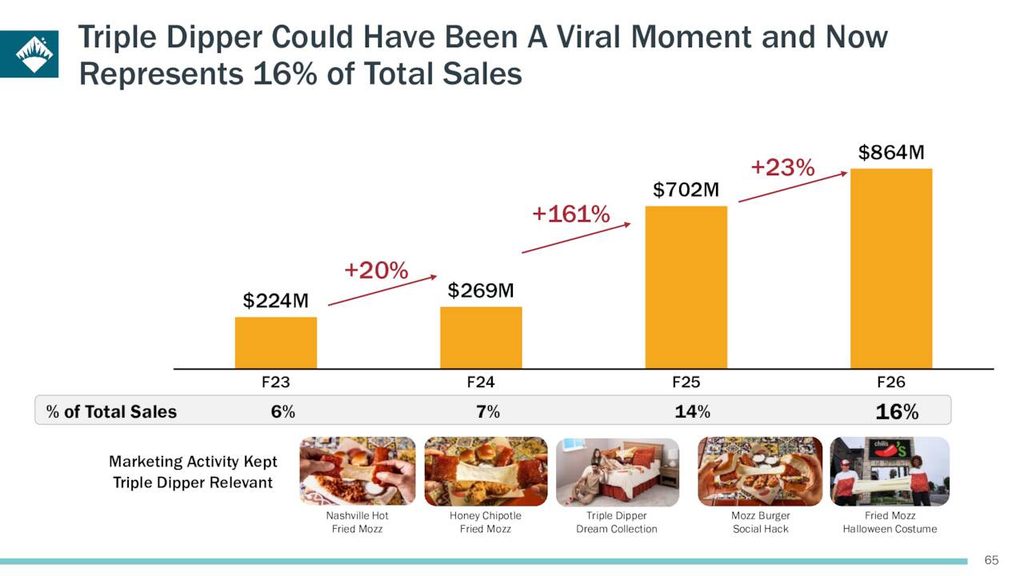
Chili’s accomplished that via innovation. After the cheese pull, it quickly launched Nashville Hot and Honey Chipotle fried mozzarella flavors. Those hit social media and came to Chili’s full menu later. The brand activated influencers to develop more content, which encouraged additional organic response from fans inside restaurants.
It then rolled playful options into the mix with Triple Dipper bedding and a Halloween outfit. “All these things were in service of keeping Triple Dipper top of mind,” Felix said. “And the results are outstanding. Tripple Dipper went from a $220 million item on our menu to now over $860 million in [fiscal 2026]. And that one item alone now makes up 16 percent of Chili’s total sales.”
He said Chili’s sees no signs of the Triple Dipper fading. Instead, it keeps scaling. It’s one example of a best-in-class social media capability the brand built to endure.
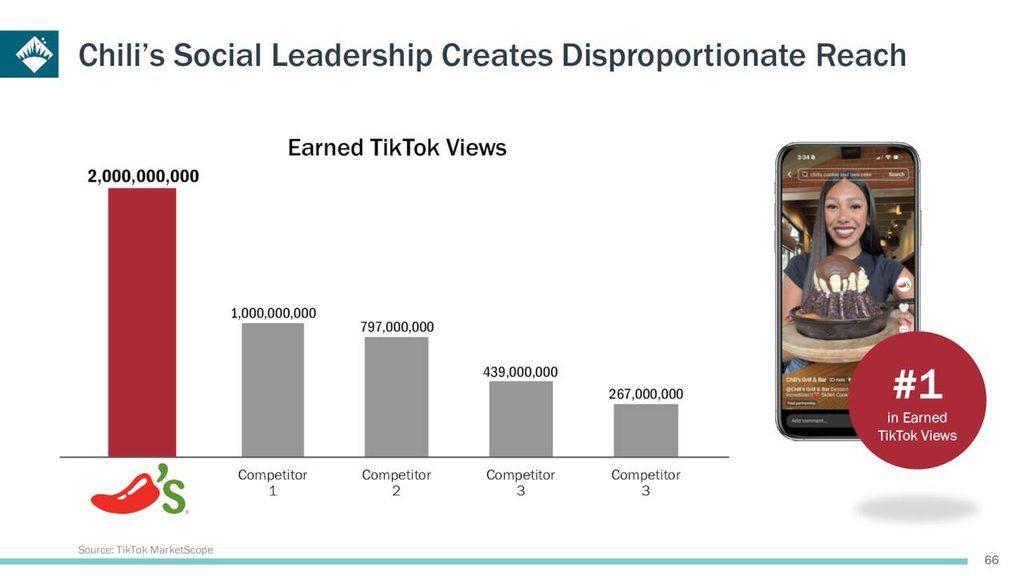
Felix said TikTok is the most influential social platform. And you can see how earned TikTok views present a proxy for relevance on the platform. Chili’s, he noted, is “far surpassing” any of its casual-dining competitors.
Another way Chili’s reaches younger generations and bigger audiences is by leveraging new communities. “I would challenge you to find another brand that can reach the Bravo reality TV audience in a really authentic way, while also being the lead sponsor of the hottest young driven in NASCAR, Carson Hocevar, and then tap into the exploding world of YouTube golf by partnering with Rhoback for a merch collection and putting Chili’s on a golf course,” Felix said. “And this is only three of a ton of different things we’ve done over the last three years.”
Yet what it shows, dressed down to an earlier discussion, is Chili’s is for everyone. It’s going to emphasize that beyond simply slapping logos on different properties.
The brand today boasts a disciplined approach to how it goes to market from a media angle.
It wants to reach a core, older audience through linear TV and streaming. You’ll see the brand “all over” college football, NFL, March Madness, and the NBA playoffs. Chili’s will be, Felix said, “where the eyeballs are.”
But with younger diners, it means using breakthrough social media and culture pops since it’s a group not watching linear programming as much. They’re scrolling social and seeing what’s trending on TikTok.
Those two universes to mesh, Felix said.
From 2024 to 2026, Chili’s added 40 million guests. It’s grown across different groups. Gen Z today comprises about 25 percent of Chili’s total mix, “which is awesome,” Felix said, “because younger guests are the lifeblood of any brand. But I often get the question, are we growing younger guests at the expense of our core audience? And I think this chart will show you that the answer is no.”
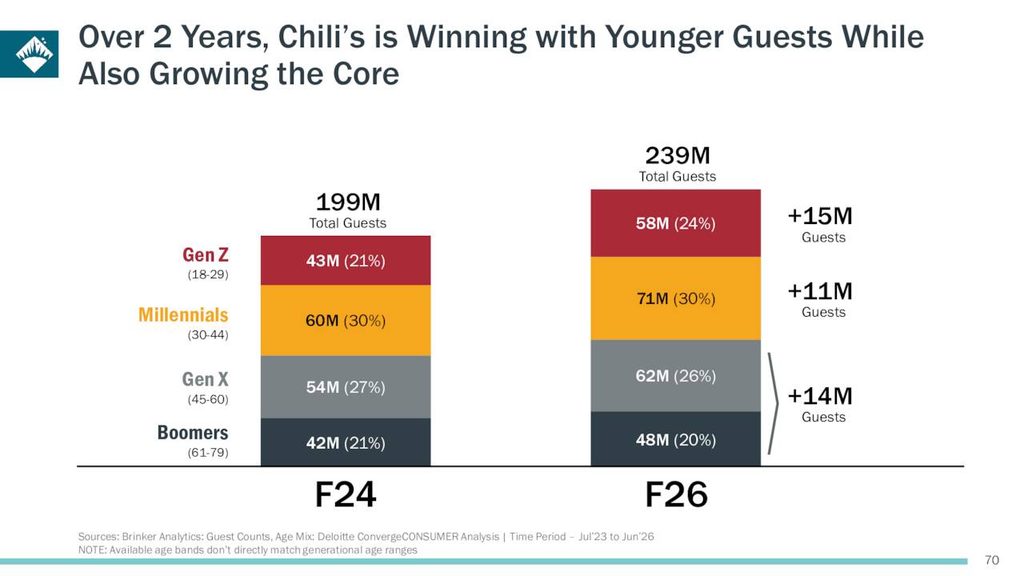
Chili’s has managed, he added, to expand appeal without alienating its core. And there’s room to go.
Casual dining is about a $116 billion market. That accounts for large and small chains and independents. Chili’s makes up about 5 percent. “So, when you think about what’s going on with the strategies that we have in place, you think about the strong brands getting stronger and the weak brands getting weaker and more consolidation happening, there is a huge headroom for growth for Chili’s to continue to steal share in this market,” Felix said.