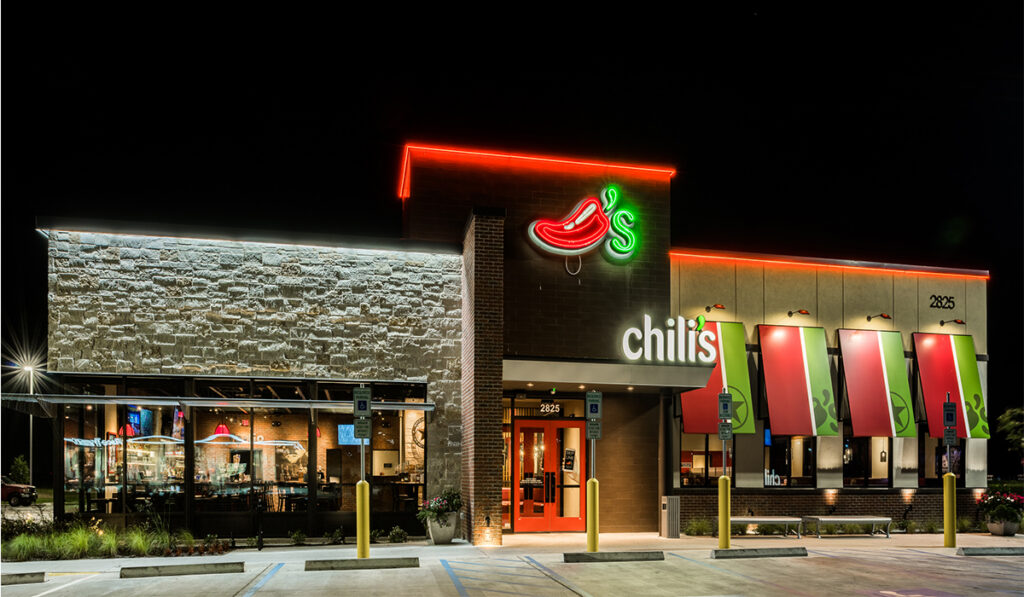
If there was any hesitation around whether Chili’s comeback was real or fleeting, the brand feels it answered all misgivings in 2026.
Chili’s posted Q4 same-store sales growth of 5.6 percent at company stores, giving it a two-year stack of 29.3 percent following a prior-year surge of 23.7 percent. Traffic lifted 1.5 percent on top of 16.3 percent for a longer view of 17.8 percent.
But wider, Chili’s result also rolled over a 15 percent bump from two years back to form a three-year cumulative comp of 50 percent. It covered fiscal 2026 with same-store sales growth of 9.2 percent, good for 34.5 percent over two years (traffic is up 19.6 percent during that span).
Chili’s has generated five consecutive years of same-store sales gains and, in one of the more answer-the-doubters stats possible, has hiked a combined 71 percent. Average-unit volumes tacked on $2 million per location to get Chili’s from $3 million to $5 million.
And if there was a year Chili’s might level off matching its own bar, it was going to be 2026. Yet the brand positively lapped all four quarters of double-digit same-store sales growth from 2025, including two north of 30 percent. Chili’s AUV rose from $4.5 million to $5 million over the 12 months.
MORE:
Chili’s Outpaces Casual Dining Again, Sees More Room for Traffic Growth
Chili’s Takes Aim at Fast Food with Big Crispy Chicken Push
Chili’s Mythical Run is Showing Signs of Longevity
Brinker International CEO Kevin Hochman, who took the role in May 2022, coming over KFC, said 2026 saw Chili’s increase its lead as the No. 1 casual dining brand for traffic. And there are a lot of options to unravel why it’s held.
One is an ongoing reality that in a difficult operating environment, Chili’s continues to divert resources to long-term initiatives, such as improving food, service, atmosphere, and employee experience, as well as positioning to be more relevant, easy, and distinctive (R.E.D. marketing being a Yum! Brands guidepost championed by former CEO and Hochman colleague, Greg Creed).
Chili’s began this turnaround those years ago with a twofold approach along the same lines—experience improvements coupled with everyday value leadership. Hochman said the brand’s per-person average spend today sits $3–$4 below competition and there’s a “powerful flywheel of traffic, sales growth, margin expansion, and reinvestment into our business” that suggests Chili’s category-busting results aren’t going anywhere.
“The American consumer demands experience and great value, and they are showing up for those brands who consistently deliver that,” he said.
Hochman noted third-party syndicated data confirms Chili’s won across all fronts. It’s ranking high in measures like value, quality, service, and overall experience, and still, has room to grow, he said. “We are very appreciative and proud that Chili’s is one of the small handful of brands the American consumer trusts,” Hochman added, “and are willing to increase their visits to. And we will work hard for our guests to maintain both our value leadership by improving our guest experience year-after-year.”
There are a host of more-granular efforts going well, too. Chili’s is about four months post-Big Crispy Launch (new chicken sandwich platform). Hochman said the chain was selling 20 per day, per restaurant, before it revamped. By end of Q4, the number was up to 55, a 175 percent rise that’s building.

That’s a bigger result than Chili’s 2024 Big Smasher launch and 2025 Big QP introduction. Neither of which were paltry. Where they share a thread, though, is in how they resonated. Size. Price. Value. Taste versus fast food. That’s a filter Chili’s will keep dropping launches through, or what Hochman called “another important chapter in our ‘Better Than Fast Food’ story that will continue to position Chili’s uniquely as a restaurant destination.”
Meanwhile, culinary upgrades were supported by buzz. Q4, along with the Big Crispy launch, included a remake of the famed 1985 Baby Back Ribs jingle with Lizzo, and more Margarita of the Month promotion.
And in another popular Creed euphemism, Hochman reminded investors Chili’s marketing strategy “is driving sales overnight and brand over time.”
So, while these programs push day-to-day performance, Chili’s ensures whatever it rolls out speaks to where it’s headed.
A case in action: Chili’s is well over two years removed from when a cheese pull went viral in early 2024. And YouGov third-party data this past quarter showed Chili’s highest level of buzz across all cohorts ever recorded.
“Chili’s is everywhere,” Hochman said. “It continues to be America’s hottest restaurant brand, and the sustained relevance of the brand proves this repositioning has legs beyond one social event.”
Again, Chili’s turnaround is a foundational reroute as well as a front-facing one. The brand today has a “North of 6” team (reference to AUVs above $6 million) that gathers Chili’s highest-volume store leaders to formally source ideas. What’s vital about this, Hochman said, is they typically boast additional perspective on how to increase throughput because their restaurants are so busy. Chili’s recently made some “very significant changes” to free up managers’ time to coach teams and be with guests on the floor.
It implemented a “ruthless simplification” of shift line checks (a set of tasks the manager is mandated to perform to know their team is ready). Chili’s took that daily process down from eight pages to one and loosened roughly 30 minutes of manager time each day.
Think about that, Hochman said, as 22 years of manager time unlocked annually across the system. “And that’s time much better spent side-by-side coaching their teams and in the dining room with our guests,” he explained.
A second change was upgrading Chili’s scheduling platform to focus on making it easier for leaders to assign the right number of employees per shift.
Lastly, Chili’s VP of operations picked, as they do each year, their “obsession metric” for fiscal 2027. Traffic was tapped for the third consecutive run. Leaders, however, also added “profit improvement.”
Hochman said they wanted to begin developing a stronger ownership culture on restaurant expense with things like R&M (repairs and maintenance). The company made profits a bigger percentage of operators’ bonus structure so field leadership could chase the importance of nailing the flow-through of incremental sales.
Last quarter, Chili’s also talked about a fresh process designed around speeding up restaurant cycle time, meaning it would examine everything that went into the total clock of kitchen prep and the dining experience and find ways to strip minutes and drive traffic further.
While most cycle time improvements seem small, Hochman said, they compound to impart meaningful effects. “Remember,” he said, “this is about attacking anything that gets in the way of a smooth dining experience, which should also improve guest satisfaction.”
This led Chili’s to something it’s calling “supermarket simple for loyalty reward redemption.” With the now-rolled out system, customers input their rewards telephone number into the Ziosk. At the end of the meal, the available discount, such as free chips and salsa, gets automatically removed from the check. The Ziosk then informs diners how much they save by being a rewards user, just like you see when you do so at a supermarket and the cashier (or screen/receipt) says, “you’ve saved X number of dollars today.”
The Ziosk software upgrade, Hochman said, will reduce the manager time needed to resolve check issues, deliver faster table turns, and, more importantly, make the dine-in experience better.
A couple of weeks ago, Chili’s hosted its annual general managers conference in Arlington, Texas. Nearly 80 percent of GMs earned more than $100,000 in fiscal 2026. Manager turnover is ahead of the industry, Hochman said, and so, too, is hourly turnover.

Can Chili’s keep it going?
As much as Chili’s has changed and refined during Hochman’s tenure, he feels three’s plenty ahead to work on. Chili’s reimage program, for instance, completed 11 updates in fiscal 2026. Based on learnings, the company plans to do another 60–80 next year. The following calendar, it’s going to look at a planned cadence of 10 percent annually.
And something Chili’s hasn’t done during its turnaround is grow materially. Brinker ended Q4 with 1,110 domestic corporate Chili’s, four international, 49 Maggiano’s, and 99 U.S. franchised Chili’s, as well as 370 international and three Maggiano’s. That splits at 1,163 company restaurants and 472 franchised.
Chili’s had one Q4 domestic corporate opening and six for the year. Maggiano’s zero. The franchised side added a lone Chili’s in Q4 and four for the year, while six opened outside the U.S. in the quarter and 23 across the calendar.
All in, Brinker opened eight restaurants in Q4 and 33 for the year.
CFO Mika Ware said development will remain “modest” in fiscal 2027 but the company already has sites in the pipeline to ramp up “significantly” the following calendar. Ware noted a new run rate will install by 2029, and Brinker plans to share more at its September 17 investor day.
Near-term, July sales and traffic “significantly accelerated” versus Q4 to keep momentum flowing, Hochman said.
The No. 1 culprit is the chicken sandwich, which hit on every metric Chili’s hoped for during tests. It’s driving value leadership and abundance and drawing a clear line between what the brand offers and what it feels fast-food competitors can.
The Bombshell Margarita landed in July and attracted younger diners. Then, Chili’s seized a social media opportunity when it started to hear guests ask for Molten Chocolate Cake on top of skillet cookies.
Hochman said the marketing team wanted to get after it immediately. But he slowed down to shore up operationally before turning things on. So, Chili’s worked on ensuring it had the proper supplies with cookies, Moltens, and ice cream to leverage noise.
That recently went into restaurants and allowed servers to ring it up properly. Teams were trained on how to make the viral combination consistently versus just looking at social media and trying to repeat videos.
Hochman said, between that and some other upgrades, it’s helped reverse Chili’s incidence decline on desserts. “We feel like it’s just a collection [of things],” he said. “And then, obviously, the continued operational initiatives on removing friction and improving throughput.”
Ware added Chili’s achieved more than 600 basis points of margin improvement since the comeback. That’s empowered it to invest back in restaurants and not overprice guests. And even with so much sales growth, stores are only at 80 percent capacity of historical guest counts.
There’s more to target.
Hochman said Chili’s shuffled a little bit of its priorities for 2027 based on “what’s happening in the zeitgeist.”
Starting with food innovation, it’s going to keep riding the chicken sandwich. That was always the plan—if it performs, keep driving from an out-of-store marketing standpoint.
Then, each quarter, Hochman said, it’s going to keep reminding teams how to execute. “It’s not an easy thing to make a hand-breaded sandwich,” he said. “So, we’re going to stay focused on that operationally.”
Next, Chili’s is in the process of revamping its kid’s menu. The new lineup was designed to bring young families in. Hochman said they know kids talk about Chili’s. It sees posts of sports teams winning and going to Chili’s after to celebrate. “So, we think this is the right time to go after the kid’s menu,” he said, sharing the brand brought back grilled chicken tenders.
This coming quarter, it’s adding mini Moltens as well as cheese quesadillas. And it recently launched floats with Blue Bell Ice Cream. Additionally, Chili’s created a Shriley Temple mocktail with sprite. The full revamp should be finished Q2 2027.
Chili’s also completed the renovation of its pasta platform and tacked on sausage. It retrained employees on what it’s labeling “pasta perfection.” Expect that feature, inclusive of a new cooking process to make items hotter, to go under the lights in Q2.
With dessert, Chili’s upgraded skillet cookies, which guests see advertised on table tents when they sit down. The ingredients are more premium and so is, as noted, the ice cream.
Cheesecake is coming back, too, in Q2 as a non-chocolate option for diners. “The other thing I would tell you about deserts that we’re learning operationally is a lot of times in casual dining, servers don’t sell dessert because they want to turn the tables on a busy Friday or Saturday,” Hochman said. “And we think we have an unlock on that one.”
Essentially, servers told leaders when they get a dessert order, it goes to the bottom of the KDS on Zone 3 (where Chili’s make them). In turn, it might take 15 minutes. So, servers haven’t wanted to sell them because of potential issues. What Chili’s is going to start doing as a result, Hochman explained, beginning with a pilot, is bump desserts to the top.
Looking further, in 2028, Chili’s will drop salads in the first half of the year followed by steaks and a “Guiltless Grill” in the back portion.
And building on its “North of 6” notion, Hochman said Chili’s will focus on the host stand early in 2027 as another way to unlock throughput. The average wait of guests currently is 15–20 minutes. Even if it can’t reduce times (although it’s going to try), Chili’s wants to manage the stand better so lobby customers have a better experience.
“There’s very difference ways you can experience 15–20 minutes,” Hochman said.
Chilis is going to examine how hosts use software to seat guests and manage the floor and retrain on how to better work with customers. “We’re obviously going to work on how do we get tables seated faster, how do we get tables bused faster,” he said.
Alongside the chicken sandwich and Margarita of the Month, Hochman noted, Chili’s Triple Dipper has grown the business “year-after-year-after-year” and is even up in Q1 2027. The brand’s 3 For Me mix settled as well. In Q3, it was just under 21 percent. In Q4, it was 21 percent.
And of that group, about 40 percent are opting into the $10.99 tier. The majority of customers eat all over the menu and upgrade where they want. “That strategy continues to play out,” Hochman said.
Regardless of what happens externally and what initiatives lie ahead for Chili’s, the dine-in experience will stick as a priority. The chain continues to find opportunity with bottlenecks, like the host stand observation. And when it finishes rolling out new UX for order tablets, Hochman expects speed to follow. There’s the dessert challenge as well, and refills with a crowded drinks station during peak hours.
Hochman estimated there’s “at least three years” of runway with making stores run smoother.
And also, off-premises, which Hochman said Chili’s hasn’t “even scratched the surface on.” To-go is about 25 percent of the brand’s business and he believes there’s opportunity to get friction out and mirror QSR players that win with digital by creating habits around reliability.
Chili’s thinks it can get there and be uniquely positioned to compete on the same angle it has for years. “Because if you look at the things we’re winning with, it’s all around the ‘Better Than Fast Food’ campaign,” he said. “… That’s the next big frontier I’m excited about because there’s so many more transactions in QSR that we could go after with the off-premises occasion.”