Outback Steakhouse is giving servers fewer tables and customers another reason to leave their grills untouched. The harder task is getting more people through the door.
Bloomin’ Brands’ third-quarter results showed progress inside its largest chain’s restaurants, with guest satisfaction improving for a fifth consecutive quarter. But those gains have not translated into traffic growth. Outback’s same-store sales increased 1.9 percent, supported by higher average checks, as visits declined 1.5 percent.
The company is resisting another immediate menu price increase to help close that gap. Bloomin’ delayed planned fourth-quarter pricing at Outback and Bonefish Grill, accepting a smaller near-term sales contribution as it works to make dining out worth the expense.
“We just don’t feel we need to take more pricing than inflation. It really boils down to that,” CEO Michael Spanos said during the earnings call.
READ MORE:
Outback’s Journey to Reignite a ‘Remarkable Dining Experience’ Continues
Why Outback is Reducing Table Counts for Servers
Outback Steakhouse Sees First Traffic Growth in Years as Turnaround Gains Traction
The decision captures the balancing act behind Outback’s turnaround. Bloomin’ is paying for better food, additional service capacity, restaurant refreshes, and more advertising in a business still losing customers. Savings from scheduling, purchasing, and utility controls are helping fund those improvements without pulling resources from the dining experience.
Across its U.S. portfolio, comparable sales increased 1.9 percent, with traffic declining 1.8 percent and average check rising 3.7 percent. Sales growth trailed the Black Box Intelligence benchmark by 120 basis points, and traffic lagged by 180 basis points.
Total revenue reached $944 million, compared with $929 million a year earlier. Excluding approximately $13 million associated with a gift card accounting estimate change, revenue was essentially flat.
The adjusted loss widened to 17 cents per share from 3 cents. Adjusted restaurant-level operating margin declined 20 basis points to 9.3 percent, and adjusted operating margin fell to 0.3 percent from 0.8 percent. Commodity inflation reached 4.6 percent, and labor inflation was 3.5 percent.
Outback’s recovery starts with making those restaurant investments visible to guests. Its updated service model limits servers to four tables during peak hours, compared with six historically. Front-of-house hospitality training followed in August.
Spanos said the smaller sections reduce the strain created when an unexpected absence leaves a server covering too many tables. Employees are earning the same amount or slightly more under the new model, helped by lower tip-sharing obligations and modestly higher tip percentages.
The changes are registering in customer feedback. Outback’s service, atmosphere, and likelihood-to-return scores each improved three points from a year earlier. Value increased two points, and food improved one point. Spanos said the chain’s scores now match or exceed key competitors.
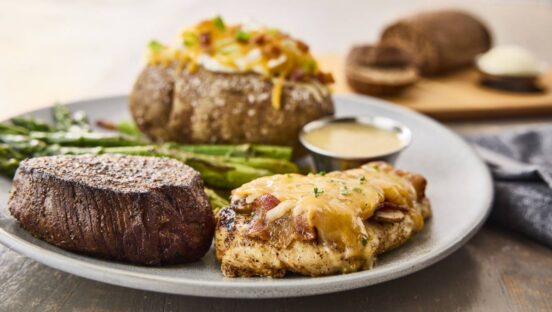
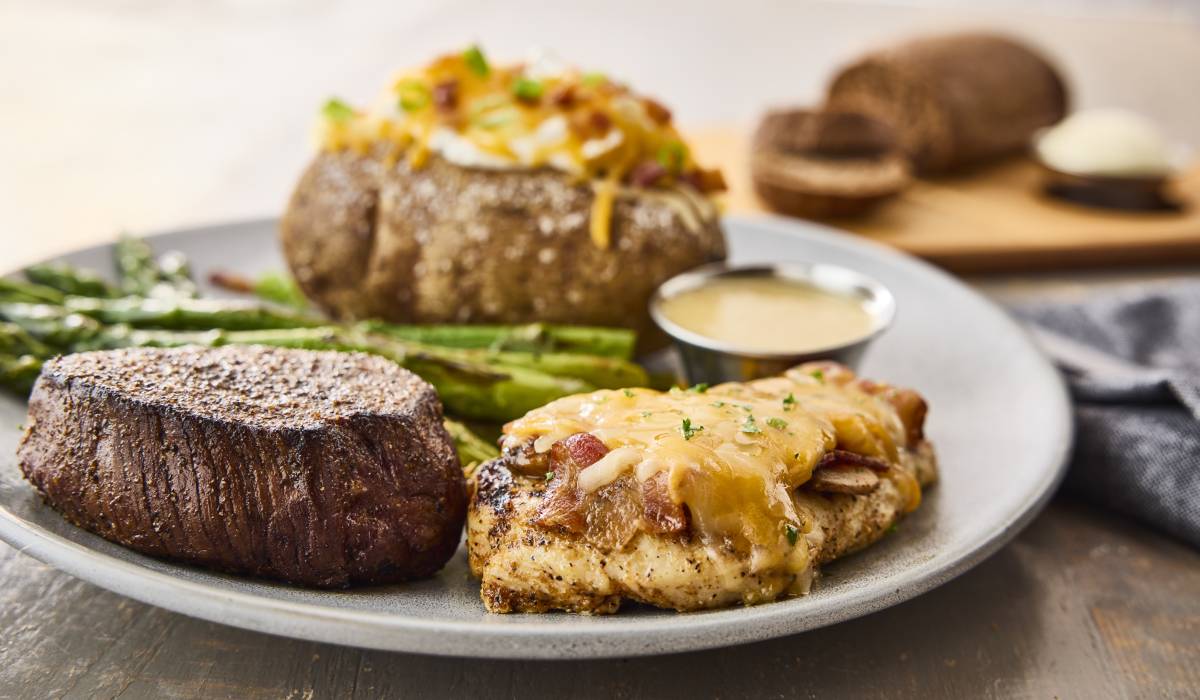
Steak preparation is another priority. The steak lineup launched last November continues to earn strong guest ratings, and multiunit operators will complete annual steak certification training again next month before certifying restaurant teams. Outback also finished expanding its chargrill equipment, giving kitchens more cooking capacity across steak and other proteins.
That work preceded October’s Best Steaks Ever campaign. Spanos said the company wanted restaurant execution and service in place before making a larger advertising push.
Bloomin’ increased annual marketing investment by $10 million, concentrated in the second half. By year-end, its media allocation is expected to reach approximately 60 percent digital and 40 percent traditional television, reversing a historical mix of 30 percent digital and 70 percent television.
The campaign combines Outback’s Australian identity and steak credentials with affordability. A limited-time offer added a 6-ounce sirloin to the entry tier of Aussie 3-Course at $15.99.
The bundled meal platform is also serving as a testing ground. Outback conducted regional tests during Q3 and is evaluating national offers to determine which price tiers and products produce the best guest response.
“We’ve got great brand equity in Aussie 3-course, our guests know it means craveable food, great service with compelling affordability,” Spanos said.
The company is giving its buildings attention, too. Outback completed approximately 61 refreshes through October and expects to finish around 85 this year, followed by approximately 100 next year. Targeted interior and exterior work is expected to touch nearly every restaurant by the end of 2028, with average spending of $350,000–$400,000 per refresh location.
Pay changes support the effort inside those restaurants. An updated managing partner compensation model took effect in April, establishing competitive local base salaries and keeping incentives connected to restaurant sales and profit growth.
Funding comes partly from changes guests never see. HotSchedules helps restaurants reduce staffing during slower periods and add coverage when demand peaks. Technology is improving control over water and utility use, and purchasing negotiations are lowering supply costs. CFO Eric Christel said Bloomin’ is targeting approximately $30 million in productivity savings next year.
A potential acquisition could add another responsibility. Out West, a domestic Outback franchisee, filed for bankruptcy and is selling 61 restaurants. Bloomin’ signed a stalking horse purchase agreement, placing it in position to acquire the locations if its bid succeeds.
The restaurants continue operating normally. Spanos described Out West’s circumstances as specific to that operator and said other franchisees are healthy and investing. The company expects the sale process to take a couple of months and does not anticipate a material fourth-quarter financial impact.
Elsewhere in the portfolio, Bonefish delivered the strongest comparable sales growth at 5.3 percent, with traffic down 0.8 percent. Carrabba’s sales increased 0.6 percent, and traffic declined 2.9 percent. Fleming’s sales were flat, with traffic down 1.9 percent.
Bloomin’ expects annual U.S. comparable sales growth of 1–1.5 percent and fourth-quarter growth of zero to 1 percent. Holiday calendar changes and comparisons against a prior-year promotion are expected to create approximately two percentage points of fourth-quarter traffic pressure. The delayed price increases also lower the sales outlook.
Spanos said lower-income households and older guests are showing some check sensitivity. His response is to make the restaurant experience justify the purchase, with steak, service, and complete meals carrying the argument.
“Second, when you look at our in-restaurant experience as a consumer, which you show up and get in terms of food, service, experience versus what you’re doing at home on the grill and if you screw it up at home on the grill, it’s on you,” Spanos said. “If we screw up in the restaurant, it’s on us.”