
Outback in June hosted its first managing partners conference since 2019. One of the takeaways for CEO Mike Spanos, a former Delta Airlines operations chief who joined the brand in September 2024, was he’s made a believer of Outback cofounder Tim Gannon, who brought forth the Bloomin’ Onion—an appetizer that’s generated more than $1.4 billion in sales over the years.
A couple of calendars in, Spanos’ four-pillared turnaround has started to receive that kind of response on a broader level. In Q2, guest metric scores achieved year-over-year gains for the fourth consecutive quarter. Compared to this period last year, numbers across service and atmosphere each bumped 7 points, value 7 points, intent to return 5, food 4, and brand trust 2.
The chain’s same-store sales rose 1.4 percent (0.8 percent two-year stack) and traffic was negative at 2.8 percent (–3.8 percent two year).
But as Spanos has said from the beginning, when he told investors they’d hear candid updates throughout the process, Outback has tried to plan through a longer-term lens that will sustain growth as execution shores up and sentiment becomes an expectation—like those recent results suggest is happening.
For instance, Outback elected in Q2 not to lap some dilutive traffic offerings from last year, particularly with third-party delivery (Outback’s off-premises mix sits at 26 percent). While still a material corner of the business, Spanos said, and one that opens the convenience funnel, the focus going forward will be on “delivering a remarkable dining experience to drive sustainable traffic growth.”
One area Outback has done so is through an Aussie 3-Course meal introduced late 2023 and tweaked since to promote a value point at $14.99, but also more premium tiers focused on elevated steak options. Spanos said about 60 percent of guests today consistently trade up from the lowest level of the barbell into higher ones. About 20 percent ladder into dessert.
As a refresher, Spanos’ outline for Outback falls into four platforms: Deliver a remarkable dining experience, as noted; drive brand relevance; reignite a culture of ownership and fun; and invest in restaurants. Meanwhile, Bloomin’ Brands will support evolutions with non-guest facing productivity savings, balanced capital allocations, and strong leadership.
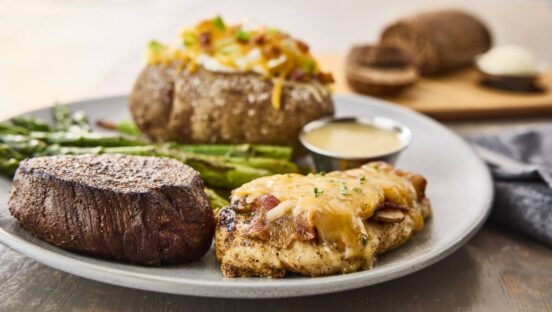
The opening goal took its first true, tangible step when Outback unveiled a new steak lineup last November. Spanos said the brand has since seen steak score “in the top box” and Ziosk customer reactions in Q2 reflected noteworthy improvements year-over-year across intent to return, food quality, service, steak temperature, and value.
With dining experience, or what Outback is calling, “Craevable Service,” the vital shift involved rethinking the company’s hospitality approach where one server oversaw six table stations during peak hours and reducing the ratio to four. That rolled in Q2 and led to positive feedback, Spanos said.
The quarter’s absolute service scores came in more than 90 percent top box and increased by nearly 3 points versus the year-ago measure. Additionally, the pay of servers was essentially in line with previous takes. Tips increased as a percentage. Tips shared fell. And employees reported more ownership over their tables. “That’s just so core to what Outback was when it was great, and that’s good,” Spanos said.
“… Like steak quality,” he added, “guests are telling us they see the difference in our enhanced service model, improving the what-you-guest-for-what-you-pay-for value equation. Our Outbackers continue to leverage the tabletop Ziosk data to drive accountability and close any gaps in performance in each restaurant.”
Coming this month, Outback will train front-of-house employees on its enhanced hospitality model “to deliver a fun, casual, Aussie, No Rules, Just Right experience,” Spanos added.
The relevancy point will start to pick up. Spanos explains it’s a matter of embracing the core of Outback’s Aussie roots by inviting customers to “come as our guest and leave as our mate.”
Expect to see communication center on the quality of Outback’s new steak lineup with a balance of brand equity and the affordability of the Aussie 3-Course offer, as well as refreshed service.
In turn, Outback will lift marketing spend, year-over-year, across the latter half of 2026. It will continue to shift mix into social and digital and push Aussie irreverence. That plus a “relentless focus” on consistent execution should bring diners back, Spanos said. Outback aims at about 60 percent digital and 40 percent linear TV.
Regarding ownership and culture, the brand tried to stress recognition among partners. The June conference was designed around energizing leaders around turnaround changes and clarifying what’s ahead.
Outback recently implemented the first phase of an updated managing partner compensation model Spanos said carries two goals: First, to ensure total cash compensation aligns with competitive realities, starting with base salaries, and secondly, to ensure total cash compensation remains tied to the growth of sales and profit of each restaurant.
And lastly, Outback is tackling the assets themselves. The brand is tracking toward a previously shared goal of touching nearly every restaurant by the end of 2028 with targeted initiatives to refresh the interior and exterior of locations at about $350,000–$400,000 per. Bloomin’ has completed about 31 Outback updates through the end of July and should have about 85 done by year’s end.
The high-arching goal is to improve ambiance and, thus, lift dine-in experience.
Refreshes predominately update tables, chairs, floors, some ceilings, and touch-ups to the bar and TV package. Outside, they focus on landscape, painting, and lights.
Spanos said about half of Outbacks today are either new or had heavy remodels over the past few years. So that leaves roughly 300 for Bloomin’ to tackle in this plan, at a rate of 100 or so a year.
Spanos estimated Outback will see a 100- to 200-basis-point lift about six months to a year after they’re done.
Additionally, the company completed the implementation of a chargrill expansion—a cooking planform that allows employees to have optimal tools for Outback’s new steak (and non-steak) proteins.
CFO Eric Christel, brought in just about a year ago from Campbell’s snacks division and PepsiCo prior, said Outback’s improving mix trends helped lower the turnaround bill.
What’s happening, he noted, is enhanced menu design encouraged combo offerings, including steak and non-steak proteins together. Also, customers are picking more premium cuts once they interact with servers and see the options. That’s happened more frequently than it did during 2025 pilots.
Spanos said there’s been nice leverage on sides as well and premium steak toppers have been well received. Desserts are up and Outback did work on elevated offerings, like a Parmesan Creamed Corn. “We’re seeing guests spending when they feel great in a restaurant,” he said.
The Aussie 3-Course has landed at the entry point, with options from Chopped Steak to a burger to Teriyaki Skewers, for households running under the $100,000 level. There’s been retention and frequency of use. The other side, Outback has observation, especially amid a K-shaped economy, movement to everything from 13- to 15-ounce to boneless 20-ounce ribeyes and so forth. “The other thing we’ve been really zoned in on is just consistency of execution, regardless of who it is,” Spanos said “They love the brand. What we hear from our guests is they love our brand when we do it right.”
Thirdly, there’s been brand-wide momentum with non-alcoholic mocktails that include low-calorie options such as a Strawberry Peach Refresher to complement Aussie-themed drinks like the “Mock Croc” and “Sharky Temple.”
Bloomin’ previously allocated $25 million for food investments, of which $18 million was specifically for mix. The company now expects the mix investment to be $4 million. Turnaround investments presently total $36 million, down from $50 million. And productivity savings remain on track for $30 million for a net investment in 2026 of $6 million.
Forging ahead, Spanos said Outback’s turnaround won’t be linear. The company will pace and sequence investments to ensure they’re targeting guest experience and employee engagement.
“There’s a cumulative effect, especially in this industry when our average guest frequency is about twice a year, where you combine what is momentum in the steak lineup, the service lineup, a service model that we have, the experience we’re going to be rolling out, and hospitality experience training over the next few weeks, and then the affordability offers,” he said.
In Spanos’ experience, turnarounds always see a flywheel. They take time. “We have locations, whether they’re franchisees or current restaurants, when they have been doing what is true to the core of the brand, we grow traffic and we grow comp sales sustainably,” he said.
Elsewhere in the portfolio, Carrabba’s reported same-store sales growth of 1.7 percent in Q2 (5.6 percent two-year stack). Bonefish climbed 8.1 percent (2.3 percent two year), and Fleming’s comped positive at 1.6 percent (5.4 percent two year).
Traffic across those brands declined 2.5 percent (–1.8 percent two year), grew 4.5 percent (6.9 percent two year), and declined 2.8 percent (–3.4 percent two year), respectively.
Check was up 4.2 percent at Outback in Q2 (4.4 percent two year); 4.2 percent at Carrabba’s (6.4 percent two year); 3.6 percent at Bonefish (9.2 percent two year); and 4.4 percent at Fleming’s (8.8 percent two year).