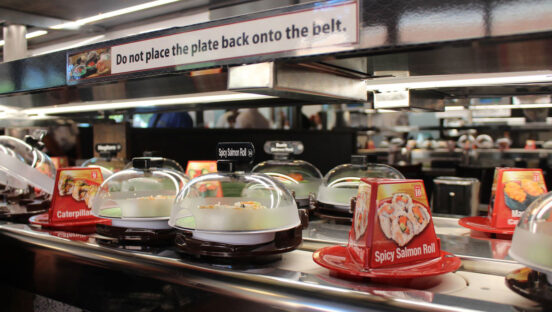

Kura Sushi’s third quarter was a “busy one,” according to CEO Jimmy Uba.
The chain’s Q3 strategies covered three main areas: completely rolling out a new reservation system, opening a handful of successful new restaurants, and building its marketing pipeline and determining how to get the most out of its collaborations.
Combined, these efforts led to negative 2.1 percent same-store sales, backed by 4.3 percent pricing and 0.8 percent mix and offset by negative 2.9 percent traffic. Kura Sushi saw sequential improvement throughout the quarter in March, April, and May. That’s a notable improvement from the previous quarter when comps fell 5.3 percent and traffic decreased 8.5 percent.
The quarter went so well that Kura Sushi boosted its annual revenue guidance to $281 million, up from $275 million to $279 million.
“The third quarter has been very busy for us, and it’s exciting that you see so many of our initiatives come online or cross the finish line,” Uba said during the company’s Q3 earnings call. “All our team members, both at our restaurants and our chief support center, have been doing incredible work to make this happen.”
READ MORE:
Kura Sushi Remains on the Growth Path, All Challenges Included
Kura Sushi Grapples with Tariff Uncertainty, but Sees Competitive Edge
The reservation system launch began in late February, ramped up in April, and was mostly done by May. Thus far, the response from guests and employees has been “uniformly positive,” Uba said. Kura Sushi believes the new system could become a major comp driver.
One notable improvement is at the host stand, where the seating process has been significantly streamlined. Beforehand, hosts had to input guest information across three terminals when seating parties, but the new system consolidates that process into one terminal. Additionally, there has been an unexpected benefit with bussing. Under the old waitlist system, staff worked with a general sense of order, but didn’t have a firm time commitment. Now, with reservations tied to specific times, there’s motivation to have tables ready promptly. This sense of urgency has pushed bussers to move more quickly, especially during peak hours, which has helped with table turnover.
Plus the chain has already identified potential upgrades. Uba said there’s a list of about 70 different aspects the chain is working on with the reservation system—fixes that should lead to “a pretty meaningful upside opportunities as it relates to front-of-house efficiencies.”
Rewards members have been organically discovering the reservation button, which replaced the previous “waitlist” option. The brand has also sent marketing messages via email to spread the word. Although the brand doesn’t have a lot of quantifiable data yet, CFO Jeff Uttz noted more than half of guests with reservations are being seated within two minutes of arrival, and that’s “night and day from what guests were used to.”
“We do believe that this is a massive, massive catalyst for rewards member registrations,” Uttz says. “And so certainly, we want to capture that.”
As for marketing, Kura Sushi launched a partnership with Peanuts (i.e. Charlie Brown, Snoopy) on April 28 after a roughly four-month pause on collaborations. In fiscal 2026, the chain expects seven to eight collaborations, which is a record number and up from the historical average of six per year, according a note from William Blair analyst Sharon Zackfia.
Uttz said Kura Sushi’s marketing partnerships have gotten “bigger and better every year.” However, that hasn’t always translated to higher sales. The brand believes having more collaborations throughout 2026 will give it more chances to discover what will be successful.
“I think the biggest frustration in the past was really sort of opportunity cost where if you had a miss, it wasn’t just that you had a miss, you had a miss that was eating up two months of your calendar that could be better spent with a better collaboration,” Uttz said. “And just by having seven to eight, which is meaningfully more than we’ve had this year and it’s the most that we’ve had of any year, we get that many more tries, so to speak, to find what the successful ones are. And based off of those successes, we know what to repeat in future years.”
Kura Sushi not only created a new role in its marketing team dedicated to researching and negotiating new licenses and partnerships, but it also established a committee to facilitate the development of longer-term strategies.
“We have a renewed appreciation for the role that collaborations play in our sales and have made investments to better utilize this opportunity that is unique to Kura,” Uba said.
Development has gone well too. During Q3, Kura Sushi opened three new stores in North Scottsdale, Arizona; Lynnwood, Washington State; and McKinney, Texas. Subsequent to quarter end, it opened two more units in The Woodlands, Texas, and Salt Lake City, Utah. Uba said many of the locations in the 2025 class have “exceeded expectations.” The Lynwood location is already a top five restaurant in the footprint.
The brand met its goal of opening 14 outlets in fiscal 2025. Five more restaurants are currently under construction. A big focus recently has been on smaller DMAs like the units in Bakersfield, California, and Fishers, Indiana, which have performed well. Future small markets include Des Moines, Iowa, and Tulsa, Oklahoma. Kura Sushi thinks focusing on these particular DMAs expands whitespace potential and provides the ability to spread out future locations, reducing the chance of cannibalizing sales.
Fiscal 2026 will be 70 percent legacy markets, but the chain hopes to reach a 50-50 split between new and existing trade areas by fiscal 2027. Kura Sushi finished Q3 with 73 locations, up from 59 in Q3 2023.