Firebirds Wood Fired Grill CEO Steve Kislow and his team like to say the experience starts the moment customers drive into the parking lot.
He conveys a scenario in which customers open their car door and are met with an aroma that reminds them of gathering around a campfire. The smell evokes emotion and memories. And according to Kislow, that fire is not only the heart and soul of the restaurant, but it’s also been the driver of “some incredible performance and growth over the years.”
Last year marked Firebirds’ 25th anniversary. In that time, the brand has carved a space between casual and fine dining, with a $38 average check. The chain is satisfying customers from two directions—those trading up for quality and overall experience and others trading down for more value.
“The beauty of Firebirds is that we have consumers across all economic categories,” Kislow says. “So where you may see some of the lower-income consumers start to pull it back a little bit, the higher-income consumer maybe isn’t going to The Capital Grille and Ruth’s Chris as much as they were before, and they come to Firebirds. So we’ve always been really insulated. And in difficult economic cycles we’ve done very well. Because if we lose to the left, we typically gain from the right.”
The numbers prove that Firebirds’ unique positioning works. The brand earned approximately $360 million in net sales last year, up from $245 million in 2021 and $180 million in 2018. Consolidated EBITDA was about $55 million in 2025, an increase from $37 million in 2021 and $18 million in 2018. In 2024, the company posted a $5.6 million AUV and $1.2 million in average store-level EBITDA per unit, leading to average cash-on-cash returns of over 30 percent. The brand has also experienced positive same-store sales in 12 of the past 14 years (excluding 2020 due to COVID).
Food mixes 80 percent while bar takes up 20 percent. As for dayparts, dinner represents 70 percent of sales and lunch accounts for 30 percent.
“I would describe Firebirds as an American grill that has a little something for everybody,” Kislow says. “No veto vote on the menu whatsoever. When a family or when a group of people are trying to decide where to go for dinner, there’s something for everybody on the menu.”
Meanwhile, growth has been methodical. Firebirds finished 2025 with 69 units across 22 states. Here’s a look at how the brand has progressed over the years:
2003: 6
2008: 15
2013: 29
2018: 47
2021: 53
2025: 69
Firebirds opened five locations in 2025 (Rogers, Arizona; Chesterfield, Virginia; New Albany, Ohio; Liberty Township, Ohio; and Annapolis, Maryland). In 2026, the chain will debut seven restaurants (two in Phoenix; Lexington, Kentucky; Lincoln, Nebraska; Wake Forest, North Carolina; Wichita, Kansas; and Creve Coeur, Missouri). Another three are already scheduled for 2027.
The company’s go-forward strategy is to “grow where you know,” meaning the goal is to densify current markets and take advantage of existing multi-unit leadership, distribution, and brand awareness. For instance, the only new state this year will be Kentucky.
“When you put up a map and show 22 or 23 states, there’s so many of them that have one, two, or three locations, which really, it’s a story of opportunity,” Kislow says. “… We’re going into where people are aware, where the brand is already successful. And we’ll go right across town to another trade area in a successful DMA and open another restaurant.”
Over the years, the restaurant box has evolved. There was a time when most Firebirds were between 7,200 to 7,700 square feet, and then it became 6,400 to 6,800 square feet. Now, it’s around 5,500 to 6,000 square feet—a sweet spot that brings more energy, more favorable buildout costs, and a facility that’s “sexier than it’s ever been,” according to Kislow. He describes the design as contemporary with a brighter color palette and more natural light. The chain has also elevated the aesthetics of its bar and incorporated more fire elements to display outside of the restaurant.
“I think we’ve taken the box and put money into the right places and just made sure that there continues to be the right size for us as well,” Kislow says.
Firebirds hopes to shake off a 2025 that “had a lot of noise in there” between weather elements early in the year, constant inflation, and tariffs. Still, from a sales standpoint, the company finished flat-ish. One highlight was lower labor costs, thanks to the brand using technology to increase productivity.
In terms of COGS, Firebirds used menu strategies to mitigate “some of that tariff noise.” Because of that initial work, the brand didn’t feel as much cost pressure in the second part of 2025 as it could have.
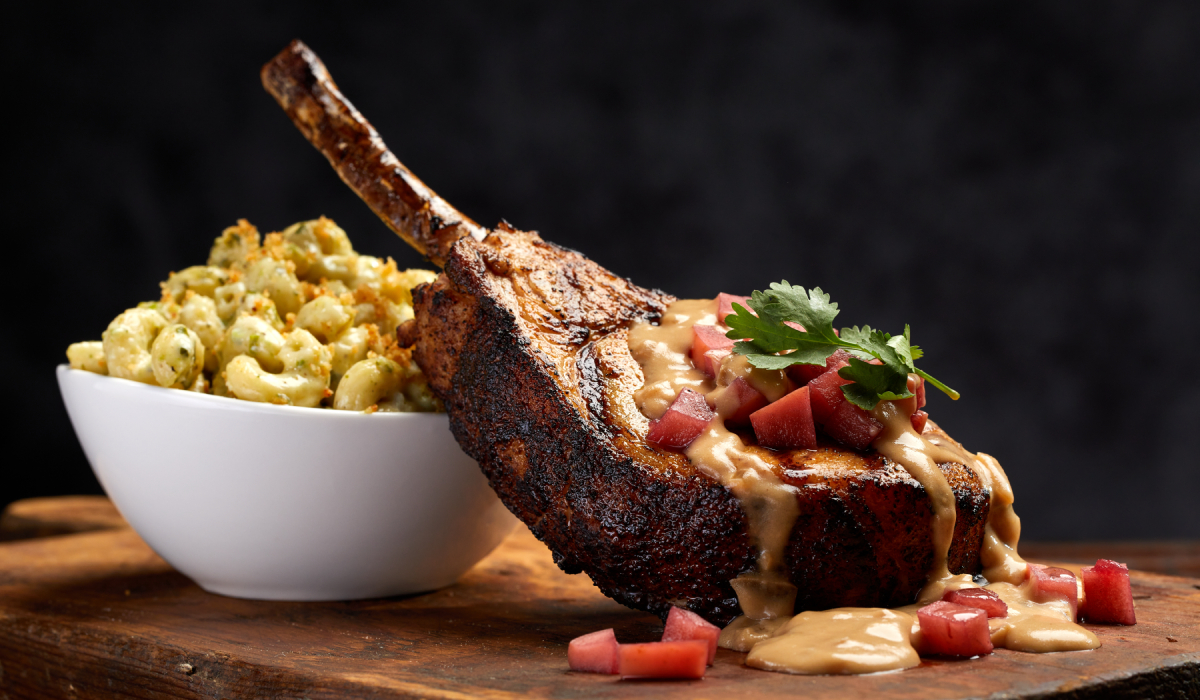
Through it all, Firebirds never lost sight of value. It didn’t change portion sizes or take a lot of price. For instance, the chain offers a three-course dinner available for $39.95, and that’s a permanent fixture on the core menu. LTOs were used to spark excitement as well, like the brand’s summer seasonal menu, which featured Roasted Chicken, Steak Frites, Shrimp & Grits, Butcher’s Meatloaf, and Steak Penne.
Another major element of 2025—the organization of data. Firebirds even created a business analytics department to better leverage all of the information at its fingertips. Kislow points to marketing and real estate as two high-impact areas. The new department allows Firebirds to “really understand from a more granular standpoint the impacts on the business, which helps us make the right decisions.”
The brand also uses an AI bot to help with phone reservations, which knows whether seating is available, answers questions, and can suggest alternative timeframes. This was tested early in 2025 and launched to the entire system in the second half of the year. Additionally, Firebirds partnered with Axial Shift to help with labor scheduling; the tech was piloted in 2025 and is currently rolling out to the rest of the footprint.
Looking ahead to 2026, the four priorities are drive sales (including more top-of-the-funnel marketing), innovate, control expenses, and attract and retain employees.
It’s an environment where Kislow feels Firebirds can win each day.
“I think one of the points of differentiation for us that I like to make sure we get across is, when you think about polished casual and the other players in polished casual, I don’t think anyone out there has the affinity for families—and families have the affinity for Firebirds—like we do,” Kislow says.