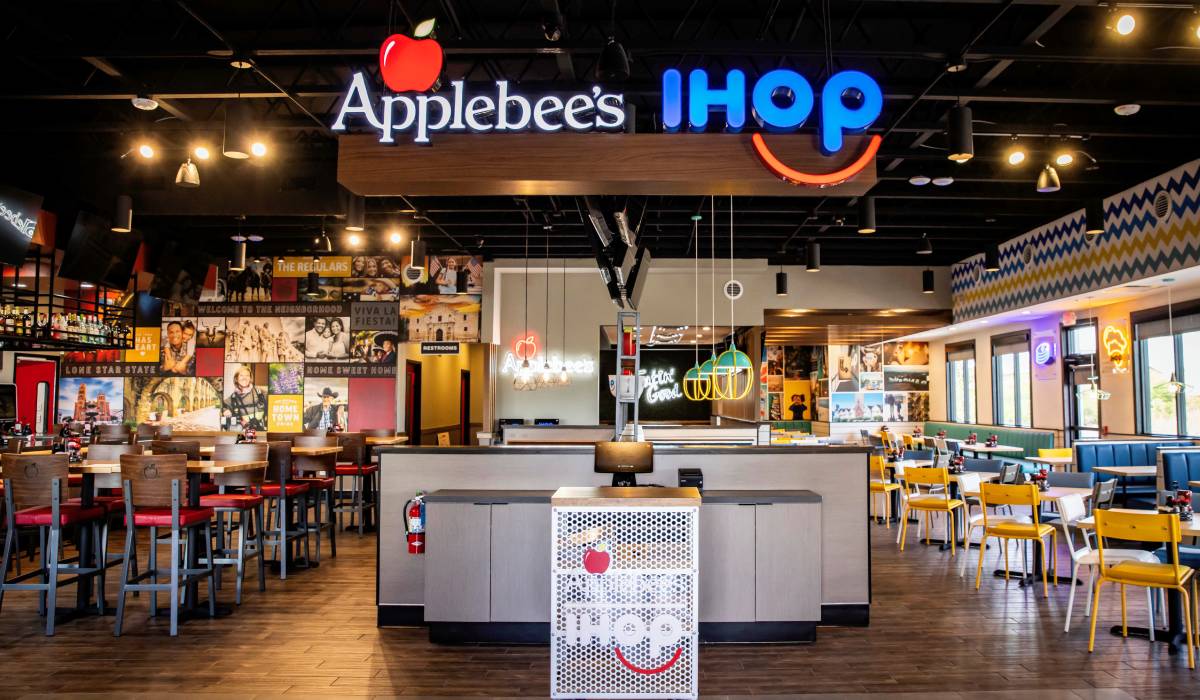
Nobody asked Dine Brands to put Applebee’s and IHOP under one roof.
But according to CEO John Peyton, guests are finding plenty to like once they walk through the door: Two-thirds of checks at the company’s dual-brand restaurants include items from both menus.
For Peyton, that illustrates an important distinction between responding to demand and creating something customers couldn’t quite picture beforehand.
On FSR’s Restaurant Innovator podcast, he discusses how the format grew from international experimentation into a U.S. development opportunity. With 60 locations open and more on the way, the effort offers lessons that extend beyond pairing two familiar names.
LISTEN TO THE FULL EPISODE HERE
1. Look for complementary demand, not just compatible brands
The logic behind combining Applebee’s and IHOP starts with when people visit.
IHOP brings breakfast strength. Applebee’s brings an established afternoon and evening business. Together, they create an opportunity to generate more sales from an existing building throughout the day.
For IHOP operators, that means addressing a historically challenging dinner business. For Applebee’s franchisees, it means adding a breakfast occasion they weren’t serving.
That distinction matters as operators contend with higher costs. Peyton sees adding an entire daypart as a different growth proposition from competing for another incremental visit.
Most locations have been conversions, allowing franchisees to spread fixed costs across more sales. “That incremental revenue flows at a higher margin than the original restaurant because the fixed costs remain the same,” he says.
READ MORE: Dine Brands Looks to Find New Ways to Win at Applebee’s and IHOP
2. Give customers something concrete to react to
Peyton argues that a focus group would have struggled to evaluate a shared Applebee’s–IHOP experience without seeing it.
Dine Brands wasn’t starting without evidence. International operators had already opened dual-brand restaurants, and Peyton visited locations before pursuing the opportunity domestically. But translating that evidence into a U.S. concept required franchisees willing to open restaurants before every detail was settled.
Those early operators understood they would help refine the format as they learned what worked.
“We had conversations with the first franchisees that the concept you open is not going to necessarily be the concept in two years, and together we’re going to refine it and tweak it,” Peyton says. “And so we went big and we went all in.”
Research followed the experience rather than substituting for it. With restaurants operating, Dine could ask guests what they liked, what needed improvement, and how their impressions changed after visiting. One early finding: Guests largely don’t care which brand’s side they sit on, provided they can order from both menus.
“One of the definitions of innovation is giving the consumer something they didn’t know they wanted,” Peyton says.
READ MORE:
How Applebee’s and IHOP Gave Customers ‘Something They Didn’t Know They Wanted’
Applebee’s CMO Michelle Chin Wants to Make Dining Out Feel Easy Again
Dine Doubles Down on Dual-Brand IHOP-Applebee’s Growth as Consumer Spending Softens
3. Combine the experience without doubling the complexity
Putting two brands together could easily mean giving the kitchen twice as much to manage.
Dine Brands deliberately avoided that approach. While overseas locations had essentially combined both menus, the U.S. team streamlined the offering to keep the total item count in line with an individual brand’s menu.
Overlapping products underwent a comparison process. The resulting burger, for example, uses an Applebee’s burger and an IHOP bun.
Still, menu editing doesn’t eliminate the learning curve. For Applebee’s teams, IHOP’s weekend breakfast rush takes some getting used to.
“There’s nothing that you can really say to prepare them for what happens on Saturday and Sunday morning at an IHOP,” Peyton says. ”No one orders their pancakes and eggs the same way.”
IHOP franchisees, meanwhile, often need support learning how to operate a bar, which he calls “the heartbeat and the cultural hub of the restaurant,” with bartenders helping build regulars and support servers.
The combined menu also leaves room for mashup items available only at dual-brand locations. Peyton’s favorite is the buffalo chicken omelet, which pairs Applebee’s boneless wings with an IHOP omelet.
4. Make innovation somebody’s full-time job
Peyton didn’t assign the dual-brand rollout to employees already juggling their regular responsibilities. Instead, Dine pulled roughly a dozen people into a dedicated team and gave them room to move without getting slowed by the broader organization.
“It was no one’s part-time job,” Peyton says. “It was a dedicated team to just work on that, and they had permission to break things.”
He also didn’t want to spend years studying the idea or open just one or two restaurants and wait a year to assess the results. Dine moved ahead with franchisees willing to take the risk.
“We found some great franchisees who are development-oriented risk-takers, and we signed up the first 10 or 12, and we opened them,” Peyton says. “And if we hadn’t done that, we wouldn’t be having this conversation today.”
5. Don’t let the new format eclipse the original brands
Peyton is clear that Dine hasn’t created a third restaurant brand.
“We have our red brand, we have our blue brand,” he says. “We haven’t created a purple brand.”
The format depends on Applebee’s and IHOP remaining compelling individually. Their menus, marketing, and identities still have to give guests reasons to visit. Even with an opportunity for roughly 900 dual-brand restaurants over the next decade, Peyton expects standalone locations to far outnumber them.
That distinction carries through to sales reporting. Guests receive one check, but Dine assigns revenue to Applebee’s and IHOP separately so it can report each brand’s comparable sales. Even for mashup items drawing from both menus, “everyone gets their fair share,” Peyton says.
“We’ve created an experience where guests can enjoy Applebee’s and IHOP in the same location at the same time, and the dual brands will only be as strong as Applebee’s and IHOP are as individual brands,” he says.