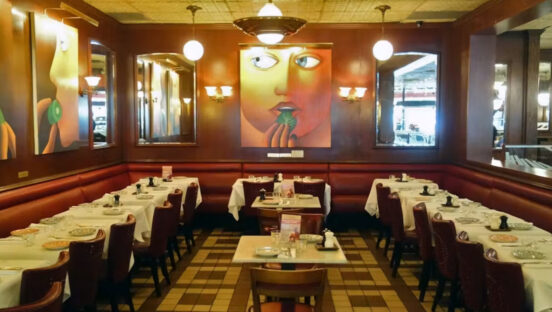

Fireman Hospitality Group, the restaurant company behind some of New York City’s longest-running dining institutions, filed for bankruptcy after mounting debt and a fight with merchant cash advance lenders left the company with less than $100,000 in available cash.
The group operates nine restaurants and employs more than 800 people, according to a declaration filed by chief restructuring officer Jordan Meyers.
The portfolio includes Café Fiorello across from Lincoln Center, Trattoria Dell’Arte near Carnegie Hall, Bond 45 in the Theater District, two Brooklyn Diner locations, Paris Bar and Le Jardin, Café Paradiso, USA Brooklyn Delicatessen, and a Café Fiorello in Washington, D.C.
The bankruptcy filing comes less than a year after the death of founder Sheldon “Shelly” Fireman, who opened The Hip Bagel in Greenwich Village in 1963 and spent the following decades building a collection of prominent full-service restaurants. Fireman died in October 2025, and his estate owns all or a majority of each debtor entity.
Café Fiorello has operated for more than 50 years, Trattoria Dell’Arte for nearly 40, and Brooklyn Diner for roughly three decades.
According to court documents, the restaurant group’s financial problems stretch back several years. It went into the COVID pandemic carrying substantial debt tied to construction cost overruns at multiple restaurants and losses stemming from a fire at one location.
Pandemic shutdowns compounded those problems. The company’s concentration around Broadway, Carnegie Hall, Lincoln Center, and other tourist destinations left it particularly exposed to the collapse of theater attendance, tourism, and Midtown office traffic.
Traffic did not return to pre-pandemic levels until the fourth quarter of 2025, the company said.
Fireman Hospitality relied on Paycheck Protection Program loans and Economic Injury Disaster Loans during the pandemic and fell behind with certain landlords. With revenue still under pressure, the company began using merchant cash advances, or MCAs, in spring 2024 to cover liquidity gaps.
Those advances eventually became a major source of financial strain.
As payments came due, the company took out more advances, with repayments eating up a growing share of its restaurant revenue. By March, more than 30 MCAs across 11 lenders were outstanding, carrying aggregate obligations of at least $5.5 million.
Fireman Hospitality contends in court filings that the MCAs constitute “criminally usurious and unenforceable” loans and says it has potential claims against some or all of the lenders. Those assertions have not been adjudicated.
The company also began taking unsecured loans in 2025 from investors, members, and friends of the Fireman family, and associates of CEO Benjamin Grossman. Those borrowings originally totaled $4.5 million. Fireman Hospitality also fell substantially behind on sales taxes beginning in October 2025 and extended vendor payment terms to conserve cash.
By March, the company determined its financial burden was unsustainable. It stopped paying MCA lenders, resumed sales tax payments, hired restructuring advisers, and pursued out-of-court agreements with creditors.
Some MCA lenders reached settlements with Fireman Hospitality. Others pursued litigation and collection efforts.
The situation worsened when certain MCA funders directed Fireman Hospitality’s credit-card processors to withhold money from the company. Since nearly all restaurant revenue flows through card transactions, the dispute threatened the company’s ability to access operating cash.
American Express had withheld funds since late April, and Toast intermittently withheld money during a similar period, according to court documents. By late July, the holds became essentially total across American Express, Toast, and Stripe.
As of the bankruptcy filing, American Express was holding at least $3.3 million, Toast at least $2.56 million, and Stripe nearly $102,000. In total, processors were holding no less than $5.96 million owed to one or more Fireman Hospitality entities.
The processors had not transferred the money to MCA lenders as of the filing, according to Meyers. They appeared to be holding it pending a court order or resolution of competing claims.
The effect on restaurant operations was immediate. Fireman Hospitality said it received essentially no revenue for more than a week after the withholding became nearly total and had less than $100,000 in aggregate available cash when it sought bankruptcy protection.
“Absent the immediate release of the Withheld Amounts and the resumption of timely ordinary-course settlement and remittance, the Debtors will be unable to fund payroll for their more than 800 employees, remit sales taxes and employee tips, pay rent and vendors, or otherwise continue operating,” Meyers said in the filing.
The company has started an adversary proceeding seeking the release of those funds and continued access to proceeds from post-bankruptcy card transactions.
Fireman Hospitality is also seeking debtor-in-possession financing from FHGRF LLC, an entity whose members include minority investors in certain restaurants, members or friends of the Fireman family, and Grossman.
FHGRF had already provided emergency financing before the bankruptcy. Fireman Hospitality owed the entity no less than $6.14 million, including at least $2.38 million advanced after payment processors essentially stopped remitting funds at the end of July.
Under the proposed bankruptcy financing, Fireman Hospitality would initially have access to $1.5 million. The company projects it will need approximately $2.3 million in new funding during the interim period, with additional financing required later.
Meyers said BankUnited declined an opportunity to provide post-bankruptcy financing and FHGRF ultimately offered the only available option.
The restaurant group carried approximately $9.98 million in secured claims as of the filing, including $6.14 million owed to FHGRF, $2.76 million to BankUnited, roughly $1.04 million in Small Business Administration EIDL obligations, and approximately $35,000 in equipment lease claims.
A consolidated balance sheet dated December 2025 listed $26.1 million in assets against $39.1 million in liabilities. Accounts payable stood at approximately $11.1 million, with another $2.36 million owed to landlords and nearly $1.4 million in sales taxes payable.
Payroll represents another major weekly cash requirement. Court documents list approximately $515,000 for hourly workers and nearly $175,000 for non-officer salaried employees each week.
Fireman Hospitality had already begun cutting its footprint before filing. Redeye Grill, which operated near Carnegie Hall for roughly 30 years, closed in July, along with a USA Brooklyn Delicatessen location. The company is seeking court permission to reject leases and contracts tied to restaurants and office space it says are unprofitable or financially burdensome.
For the surviving restaurants, the bankruptcy is meant to provide time to stabilize cash flow, continue operations, address creditor claims, and pursue a sale of assets or a restructuring plan.
Without access to new financing and its card proceeds, however, the alternative could come quickly.
“Without access to additional funding and the continued use of cash collateral as contemplated under the DIP Facility, the Debtors would suffer immediate and irreparable harm, and would be forced to pivot to a liquidation,” Meyers said.
Fireman Hospitality is the latest restaurant operator to land in bankruptcy court after relying on merchant cash advances, following filings by franchisees of Subway, Del Taco, Woody’s Bar-B-Q, and Farmer Boys, and Shari’s and Coco’s Bakery parent Lena Brands.