Restaurants have embraced new technology over the last five years. Restaurant operators now have AI tools, integrated CRM platforms, advanced POS reporting, and kitchen automation, and they can access all of the new tech with relative ease. This new-age tech promises improved efficiency, better visibility, and tighter control over the guest experience. The promise of new technology often delivers. These new restaurant innovations are amazing, but they often overshadow one of the most effective and longstanding tools in restaurant operations: Two-way radios.
Walkie-talkies and headsets don’t get the same attention as AI-powered analytics or guest-facing digital tools, but they remain among the best ways to improve communication, which is one of the biggest issues hurting restaurants. Establishments that succeed do so because they can communicate quickly and clearly in real time.
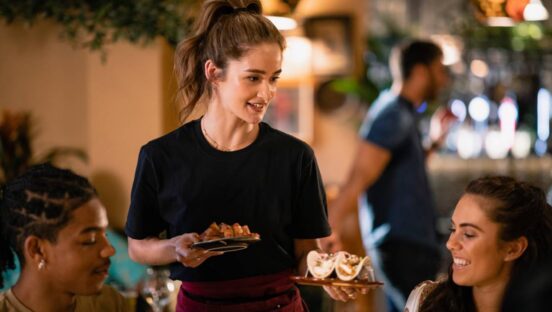
Communication matters because restaurant operations remain physical, fast-moving, and unpredictable. So many things can happen at once. A server needs water for a table. A host needs a manager. A larger party’s order is ready. A guest has a menu question, or a spill needs attention. These scenarios are commonplace in a busy restaurant and addressing them too slowly will kill service.
For restaurant operators, especially those still working with leaner teams than they had pre-COVID, that real-time communication is even more critical, according to Richard Stark, former restaurant executive and now Senior Business Consultant at Waters Business Consulting Group in Scottsdale, Arizona.
“The communication challenges have worsened since COVID, largely due to a diminished workforce,” Stark said. “Restaurant owners now have to do more with less.”
That constant pressure has pushed many operators to adopt new systems across their businesses. However, digital dashboards aren’t very effective at addressing immediate coordination issues.
“Reducing workforces means operations struggle to provide the level of hospitality or guest service that is required,” Stark said. “This means teams need to be more efficient in their communication, and two-way radios have been essential because they allow restaurants to take care of guests despite smaller staff.”
This idea explains why this technology has remained so resilient. Restaurants can use the most advanced software, but that technology overlooks the fact that the industry still largely depends on people responding to each other as quickly as possible. Radios close that gap faster than any other tool, despite being decades older. Two-way radios don’t require you to unlock a screen, open an app, or type a message. They require you to push a button and speak. They eliminate the need to search across the dining room or back of house to find someone. One quick push of a button can redirect labor, solve a problem, and keep service moving.
Stark said the value of radios increases with the size and complexity of the restaurant.
“Two-way communication becomes more important as the property size and operational complexity increase,” Stark said. “Smaller restaurants may not need radios, but a moderately sized property, 4,000 square feet, will definitely need a two-way radio system.”
As restaurants become more layered, communication becomes increasingly necessary.
“Communication is foundational to restaurant success,” Stark said. “Real-time communication is an advantage. Customers want to go to a restaurant where staff can respond more quickly and effectively to their needs.”
That has been the experience at La Buena Vida, a Mexican restaurant in Fort Collins, Colorado. Owner Hugo Caballero said headsets have become central to how his team operates. The restaurant has 30 employees and serves roughly 500 guests on an average day.
Caballero began using two-way radios during the COVID-19 pandemic.
“During the pandemic, we could only offer outdoor seating, so we used these cheap walkie-talkies that were loud and disruptive to customers,” Caballero said.
The restaurant’s outdoor seating operation expanded when the patio became a permanent fixture, but this meant the staff at La Buena Vida had to run around more than ever to find the right server.
This led Caballero to upgrade his two-way radio system and equip every member of his staff with earpieces, connecting the team more seamlessly and with less disruption. The benefits showed up almost instantly in the small operational moments that make or break the guest experience.
“If I have a server at a table, instead of my server having to go all the way to the water or iced tea station, they can radio our busser to bring more water,” Caballero said. “We have our host, our bussers, our waiters, and our chefs. We all hear it. The instant service has been everything for our restaurant.”
That type of coordination is impossible without the instant communication two-way radios provide.
“We can all hear it and go to it, so we aren’t looking for each other to communicate,” Caballero said. “It helps us respond to customers quickly and lets every part of the restaurant know what is going on.”
Old-school communication tools still matter in a modern restaurant environment. Much of today’s technology helps operators analyze, forecast, automate, or market. This is great, but successful restaurants still run on execution. Radios help teams execute, and that is where the guest experience is won or lost.
Two-way radios may not feel like the next big thing in an industry that is constantly evaluating the next big thing, but they continue to deliver what restaurant owners need: efficient communication.
“I strongly recommend that restaurants use two-way radios,” Caballero said. “They have become one of our restaurants’ most important tools.”
Restaurant owners love two-way radios for their ability to consistently deliver on their promise to improve communication, even in an era shaped by new technology.
Stewart McClintic is the owner of HQ98.com, a two-way radio retailer in Scottsdale, Arizona. They specialize in helping restaurant owners integrate two-way radios into their operations.