
Jim Mazany has operated within the polished casual arena going on 30-plus years, dating to the early 1990s with Carlson Restaurants Worldwide (TGI Fridays) and through some of the category’s icons in Applebee’s, Joe’s Crab Shack, Fatz Southern Kitchen, and multi-concept operator SPB Hospitality.
Like any restaurateur those days, he admired from afar the rise of a concept that found scale in a segment no sit-down chain had, or has, since.
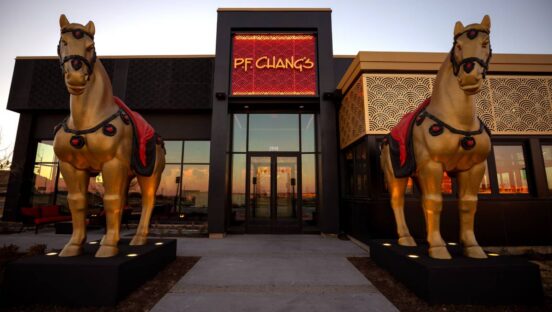
Philip Chiang and Paul Fleming started P.F. Chang’s in July 1993 in Scottsdale, Arizona. It’s grown to 20-plus countries and 300 global stores (about 200 in the U.S.)
But it had begun to drift through ownership swaps and leadership moves.
Mazany was named CEO in November 2025, making him the fourth lead executive in about two years. He succeeded former COO and CFO Brad Hill, who elevated in April and left after a few months. Hill stepped in for ex-Panera Bread chief brand and concept officer Eduardo Luz (today with Pizza Hut). He held the title since October 2023 and followed interim CEO Rohit Manocha, holding a spot vacated when now-Red Lobster CEO Damon Adamolekun departed in early August 2023, ending a tenure dating to 2020.
Adamolekun was a partner at private equity firm Paulson & Co., which teamed up with TriArtisan Capital Partners in 2019 to buy P.F. Chang’s for about $700 million. It was previously owned by Centerbridge Partners LP, a group that bought it in 2012 for $1.1 billion.
Centerbridge is also the firm that once directed CraftWorks, an entity that ultimately became SPB after Fortress deployed a $93 million credit bid to buy 61 locations and form the group.
In plain terms, Mazany saw a brand, he says, in need of believing in itself and what it could be again.
“I thought that was a big, big takeaway,” Mazany says. “For me, being a restaurant guy and being a hospitality guy, I felt like I could give this brand a sense of what winning looks like and tap into that pride and heritage of what the brand has always stood for.”

He knew P.F. Chang’s had the roots and equity. There were operators in the field and employees ready to engage. It was more a matter or reenergizing the chain. “And [add] a sense of urgency and purpose,” Mazany says.
So, where to begin? P.F. Chang’s average-unit volumes were about $4.2 million as Mazany took over, and the company generated just shy of $1 billion in revenue. For perspective, AUVs were $4.1 million when Centerbridge started exploring a sale those years earlier.
Mazany didn’t believe it was a smart approach to examine P.F. Chang’s 200 restaurants and tell everyone what was going wrong. Instead, he outlined what success might look like. “Every guest who comes in is an opportunity to delight and exceed expectations,” he says. “And really good operators always have a principle of the guest experience will never exceed the employee experience. You have to start by building an employee base of people who are committed and who believe in what we do. That’s what I first work to do in an organization—make sure there’s a belief system and value system in place.”
“It’s about execution in restaurants,” Mazany adds. “Strategy doesn’t win. Operations wins by every visit that a guest has; 7:30 on a Saturday night is not about your board deck and your strategy. It’s about how does that guest leave your restaurant feeling and what did you do to deliver the experience.”
Mazany spent the first couple of months getting into the field and learning. He asked about past wins and what P.F. Chang’s felt like when it was at its best.
Mazany says the brand had to strip away things getting in its way and figure out how to take the shackles off at times, especially with culinary innovation.
And before unpacking some of what followed, he says this narrative isn’t a comeback any longer. “It’s turning into a significant growth story,” Mazany says.

He explains when he began working with P.F. Chang’s, it was 22nd among companies in its set by sales and traffic. Now, following Q2, it’s No. 3.
The brand exited the period with same-store sales of 7.7 percent, including 6.8 percent traffic. Mazany says P.F. Chang’s hasn’t taken price since he got there outside of implementing a barbell ladder last year with $13.99 Lunch and $16.99 Dinner Specials in addition to $8.99 Cocktail Collections.
What P.F. Chang’s did was emphasize experiential dining and work to own a category it originally defined at scale. This meant putting its wok and fire cooking on display, as well as pushing three- and five-course meals to clarify value through a theatrical lens.
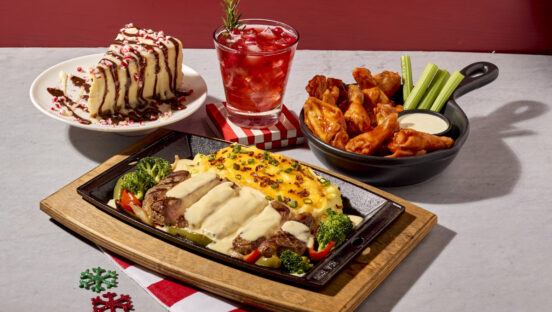
In May, P.F. Chang’s rolled a fresh lineup with a focus on “immersive presentations.” An example being a Smoking Kung Pao Dragon Roll finished tableside with smoke.
In honor of Mother’ Day, Father’s Day, graduation milestones, and other spring events, P.F. Chang’s dropped a limited-time dining experience around “Sizzle. Share. Celebrate” that ran five courses and started at $89.99 per person. Items ranged from NY Prime Strip Steak Tataki on the premium spectrum to BBQ Pork Spare Ribs.

A “Summer in Tokyo” menu, released in June, debuted a Sushi Boat that showed up to tables shrouded in a cloud of dry ice. P.F. Chang’s teamed with lead female “superyachties” Captain Sandy Yawn and Chief Stewardess Aesha Scott on exclusive content, as well as 20 additional influencers.
Mazany says he wanted to devise a moment capable of cutting through generations and present something other chains couldn’t. Employees tapped the boat with water and a “cloud” started floating through dining rooms. “Everyone is having that moment together,” he says. “And when you think about value and price, I have always said, value is how someone makes you feel in the dinning experience. And how you feel about that exchange for the dollars that are spent. Our job as restaurateurs is to be theatrical and to create these moments in dining that really are unique.”
Overall, this philosophy paid off, Mazany says. Valentine’s Day was the busiest in P.F. Chang’s history, with 173 of 200 locations setting sales records. Mother’s Day then became No. 2.
And, Mazany says, it didn’t stem from price. “It came from execution,” he notes. “And it came from really focusing within the four walls on giving the guest what they want. Getting them in and out for pacing and sequencing the experience.”
“… With the sales increases and the guest counts, this is really a guest-led recovery,” Mazany continues. “It’s led by employees first, and we’re really seeing the guest reward us.”
P.F. Chang’s has extended to smoking cocktails, sushi, and dumplings, which are brought over with sauce poured tableside, and more. Any manner P.F. Chang’s can sizzle, smoke, ice, and create an experience that’s different, yet uniquely on brand, Mazany says, is going to find a place on the menu. It’s a lane competitors can’t breach, he says.
For instance, a new lobster tail and prawn fried rice was introduced and cooked with a velveting process that’s almost like poaching. It arrives with a scorched lemon. “You’d say, would I get something at a P.F. Chang’s like that? Maybe years ago, you wouldn’t,” Mazany says. “But today, we’re leaning in.”
It’s given P.F. Chang’s a chance, he adds, to appeal to more adventurous diners alongside broad ones, which led to higher volumes and a position ripe for special occasions. AUVs, Mazany says, are now tracking toward $4.6 million to $4.7 million by year’s end. The larger goal being $6 million per restaurant.
And it continues to come back for P.F. Chang’s to flexing muscles it hadn’t in a while. Mazany talks internally about “pride,” which he broke apart as “passion, respect, integrity, discipline, and execution and excellence.” He wants employees to feel that about their jobs and the company.

While he resets this core, P.F. Chang’s also innovated on the backend with recently promoted VP of Technology Chris Patten, who has been with the chain for nearly five years, starting as senior director of infrastructure and engineering.
Mazany says Patten brought discipline around the utilization of AI and is working toward enabling people to move faster and be more productive. Efforts are starting to unfold at HQ from procurement to ordering to analytics and labor deployment. “I’m not looking at it from a people replacement point of view,” he says. “I think what we need to do first and foremost at P.F. Chang’s is get to our potential. We have such a huge road ahead of us. And we’re not going to cut our way to prosperity. We’re going to invest in people and we’re going to invest in the infrastructure.”
One of those elements is telling its story. P.F. Chang’s brought in Holly Smith in January as CMO. Smith and Mazany worked together for the past 15 years across multiple chains. She’s led transformation plans at brands like Rosa Mexicano, Yardbird, Macaroni Grill, and Joe’s Crab Shack.
Mazany says P.F. Chang’s was a “little sleepy.” With Smith, it’s pushed resources into multiple channels and tried to widen the funnel. The chain grew more than 250 million impressions this year. “We’re finding people where they are and being at the right place. I think we’re just getting started,” Mazany says.
As far as expansion goes, P.F. Chang’s entered the year with 40 percent of its U.S. stores in “A” level malls. Dine-in mixed 65 percent of sales and off-premises broke apart as 60 percent delivery, 30 percent takeout, and 10 percent catering.
The nearly 100 international restaurants were led by 25 franchise partners and, combined with seven airport restaurants, produced about $300 million per year. P.F. Chang’s also has a CPG business accounting for $220 million annually, working with ConAgra Brands to sell packaged food in about 50,000 locations (90 percent frozen meals). There’s also fast-casual spinoff Pagoda Asian Grill. The company separated from counter-service offshoot Pei Wei in 2017 (it was sold by Centerbridge to Lorne Goldberg in 2019).
Mazany says he doesn’t want to chase growth for number’s sake. His hope is to focus on quality openings and, eventually, expansion will be the outcome of well-run restaurants. Simply, Mazany feels, P.F. Chang’s will ultimately earn the right to scale again.
The brand’s five-year plan calls for 40 U.S. openings and 50–75 outside the U.S.
“I think we can get there by delivering on the experience and creating this feeling with the guest that you can trust us,” he says. “We want to be able to open in a new town or city and know it’s a good investment.”
Now that the business is profitable and trending upward, Mazany is working toward more holistic goals. The company is partnering with Starlight Children’s Foundation to support kids in hospitals around the U.S.
In honor of 2026 being the “Year of the Horse,” P.F. Chang’s will offer a small plushie in restaurants and hospitals to raise money for children in need. Mazany hopes the brand can collect $500,000 to give back, or perhaps $1 million. Called, “Spirit of the Zodiac,” it marks the start of a new annual giving initiative inspired by the Chinese zodiac and designed to bring each year’s symbol to life through a unique campaign.
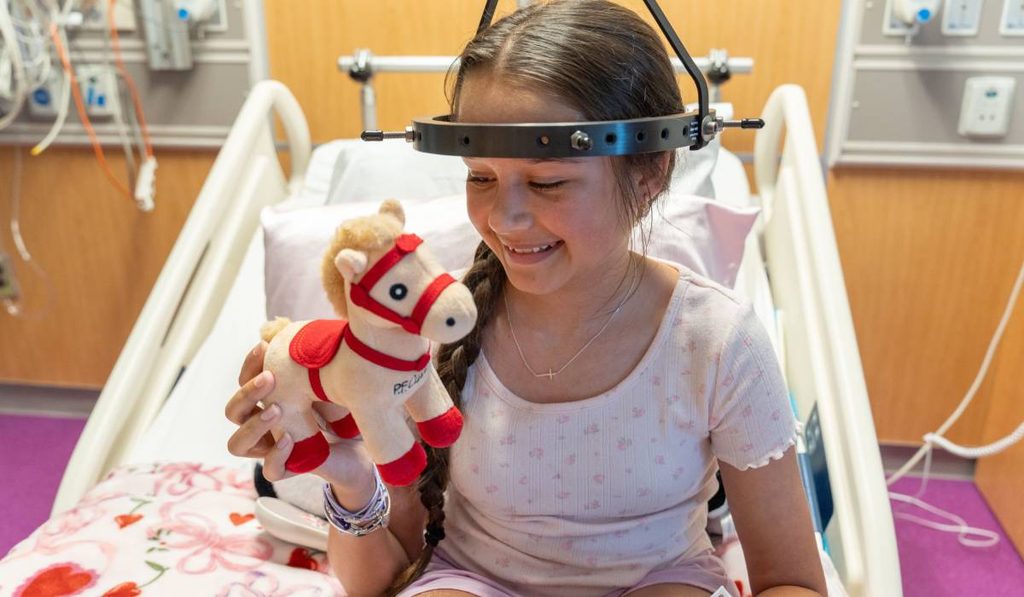
The initial version, “Year of the First Horse: Spirit of Strength,” will run a month and center on “Bao,” the brand’s logo. There will also be an original children’s book from author Jenny Liao and illustrator Adriane Tsai expected to publish later this month.
From September 2 through, Bao will be available for $10 via dine-in transactions at restaurants and for each purchase, P.F. Chang’s will donate an identical plushie to Starlight Children’s Foundation up to a cap of 20,000. Customers who purchase Bao or give $10 or more, receive an offer for a free appetizer with purchase of an entrée.
This is something Mazany valued at past jobs and believes P.F. Chang’s is ready to dig in and leave a larger imprint.
And with restaurants themselves, more culinary differentiation lies ahead, whether it’s going to be duck wings, wagyu egg rolls, or more.
“Winning is about having success and being able to deliver,” he says, “whether it’s a shareholder or an employee. And we’ve done that in a disciplined way. … I think P.F. Chang’s is back and you’re going to hear a lot of great things in the years to come.”