No one in the public restaurant industry—QSR or casual dining—is performing like Chili’s right now.
The brand’s same-store sales rose 24 percent in Q4, outperforming the casual-dining industry by 1,890 basis points. This lapped 15 percent growth in Q4 2024 for a two-year comp of 39 percent. The same-store sales were fueled by a 16.3 percent rise in traffic, a 4.7 percent increase in mix-shift, and a 2.7 percent uptick in price. Chili’s has beaten the industry on traffic for seven straight quarters and completed its 17th straight quarter of positive same-store sales growth.
For the year, Brinker International (Chili’s and Maggiano’s combined) reported total revenue growth of 21.9 percent, eclipsing over $5 billion in revenues for the first time in its history.
READ MORE:
Chili’s Still Shows No Signs of Slowing Down in Q3
A Deep Dive Into the Chili’s Turnaround that Shook Up Casual Dining
How Chili’s Went From Nostalgic Brand to Viral Sensation
The fourth quarter marks three years since Chili’s implemented its turnaround plan, with CEO Kevin Hochman joining the team in June 2022. In that time frame, the chain eliminated more than 25 percent of its menu and focused on improving its “Five to Drive” core culinary categories—burgers, crispers, fajitas, margaritas, and the most recent addition, the Triple Dipper. Chili’s now invests more than $160 million more in labor than it did in fiscal 2022, spent over $100 million on maintenance and repairs for restaurants across three years, and boosted its marketing investment from $32 million in 2022 to $132 million in 2025.
Also, Chili’s was able to pay down over $570 million in outstanding debt in the past three years thanks to its sales performance and work on the P&L.
“We have now started the year four of our turnaround, and there are some that have questioned the sustainability of our results, which is a fair question given the history of casual dining and of Chili’s,” Hochman said during Brinker International’s Q4 earnings call. “Our strategy that we shared 2.5 years ago at our Investment Day was simple: address the key fundamentals to winning casual dining for the long term, food service, and atmosphere.”
As a result of these changes—and the Triple Dipper and mozzarella stick cheese pulls going viral—since 2022, comps have grown 40 percent, AUV has lifted from $3.1 million to $4.5 million, and operating margins have increased from 11.9 percent to 17.6 percent. Food scores have never been higher and “guests with a problem”—a metric Chili’s tracks daily—has never been lower. Additionally, because of the maintenance improvements, “our estate has never been in better condition than it is today,” Hochman said.
“Chili’s is a completely different concept today than it was three years ago,” Hochman said. “Those who believe our success was driven solely from a cheese pull in social media are just not close enough to our story. Yes, internet virality and TV advertising will bring new guests in, but that success is fleeting and short-lived unless the experience they have in their restaurant matches what they saw in advertising.”
The brand continued its menu improvements by relaunching its ribs platform at the end of Q4. Thus far, guests are “raving about the look, the size, and the taste of the ribs,” Hochman said. Chili’s plans to give restaurant teams a quarter to get execution under control, and then in Q2, the chain will turn on digital marketing to use the ribs to drive traffic.
“We spent almost two years fixing [ribs], fixing the process, getting to a much bigger rib spec, getting to a better recipe, better smoking, crust on the ribs,” Hochman said. “We had to get new equipment to do that. And I promise you, go in and get a full rack of ribs, you’re going to be blown away. I mean it’s pretty awesome, and I’m pretty excited about that product.”
The chain also launched a frozen margarita program featuring a new premium Patrón frozen base with new Taylor margarita machines that “deliver a superior marg texture as well as have a larger production capacity.” Chili’s is now selling twice the number of frozen margaritas, even with the higher $10 price point.
In terms of value, Chili’s launched its Big QP burger at $10.99 as part of its 3 for Me value platform. And although the brand put a lot of marketing weight behind the menu innovation—including a pop-up event in New York City’s Union Square—the company kept its 3 for Me mix flat at under 18 percent and reduced the $10.99 mix to 7.7 percent, meaning customers are still coming in and trading up to premium menu items.
Chili’s plans to release another message around its $10.99 price tier in the back half of 2026.
“We need to make sure we continue to bring news to value, keep it exciting for the guests,” Hochman said. “We have a lead right now versus some of our competitors. We can’t let our foot off the gas.”
Operations were a target in Q4 as well. TurboChef ovens—which put out less heat in the kitchen, cook more evenly, and are easier to clean—have been installed in all restaurants. Chili’s also continued to simplify its menu by eliminating a net of 10 SKUs and eight food and drink items.
As for fiscal 2026, the brand will be rolling over 30 percent same-store sales increases in Q2 and Q3 and 43 percent growth in November.
The main focus for this fiscal year is to drive traffic, and Chili’s plans to do so not only with ribs and frozen margaritas, but queso and nacho upgrades at the beginning of Q2 and a major relaunch of its chicken sandwich platform in the back half of the year. In addition to those rollouts, Chili’s will make investments in more premium mayo, ranch, bacon bits, and 50 percent thicker bacon—the main building blocks in many of its recipes.
To further improve operations, the company will see several simplification rollouts and take processes from $6 million AUV restaurants and bring them to the rest of the system to increase throughput. Chili’s will also release a hospitality initiative that includes a new labor scheduling process. When it comes to technology, the chain will simplify its handheld tablets to feature a more intuitive design and remove over 700 SKUs that are no longer sold but still show up. The tablets will also have an offline mode in case the internet connection goes down and an easier split check capability. Another tech improvement is the upgrade of WiFi throughout the system; this means cellular backup if the network fails, higher speed internet for stores on older technology, and better WiFi coverage.
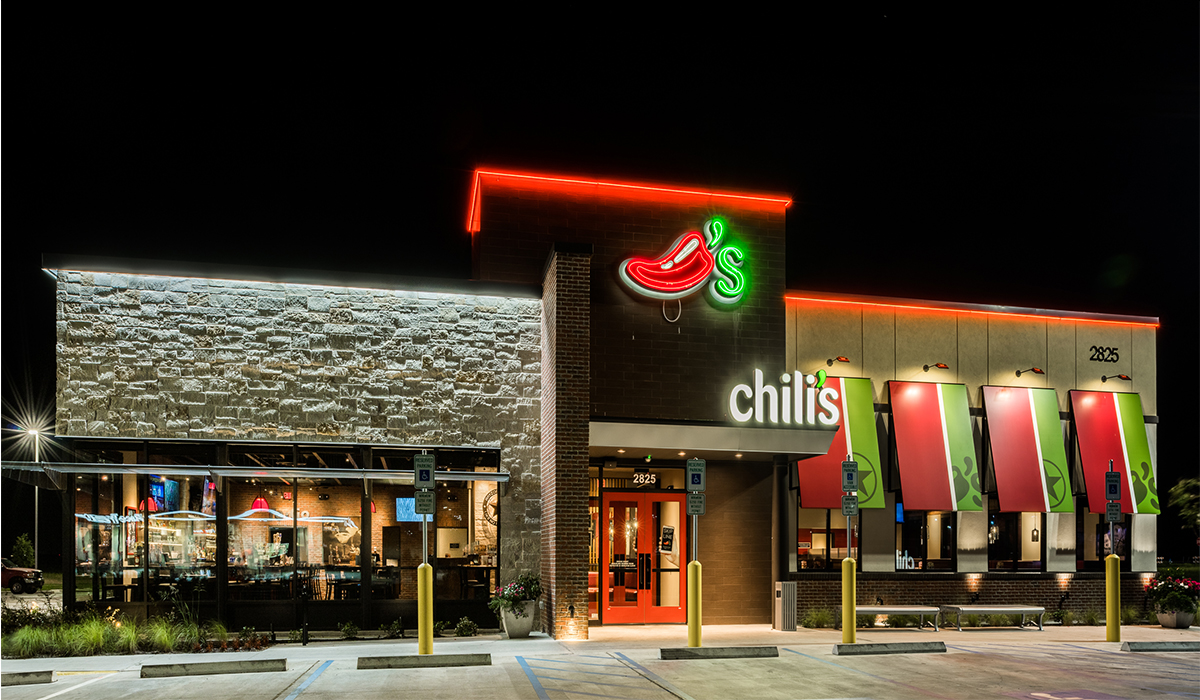
Chili’s will also get a better look from the outside. Thanks to an improved cash position, the chain can now afford to build a reimaging program too. Chili’s is on track to complete its first four remodels by the end of the calendar year. The goal is to remodel 10 percent of the system annually, which means restaurants are refreshed every 10 years. The hope is to reach the 10 percent run rate by the beginning of 2027.
“We’re not in a rush to reimage. We’re in a rush to get it right,” Hochman said. “And then once we get it right, we’ll move with speed. So right now, we’re just going to get those four reimages. We’re going to learn from them. And then hopefully, we’re going to ramp up more in the back half of the year.”
Chili’s expects positive sales and traffic in every quarter of fiscal 2026, with Q1 showing the strongest same-store sales growth and more moderate gains in subsequent quarters because of last year’s high compares.
The chain finished Q4 with 1,208 restaurants systemwide, 1,109 of which were company-owned. Chili’s is the sixth-largest casual-dining chain in America, behind Waffle House, IHOP, Applebee’s, Denny’s, and Buffalo Wild Wings.