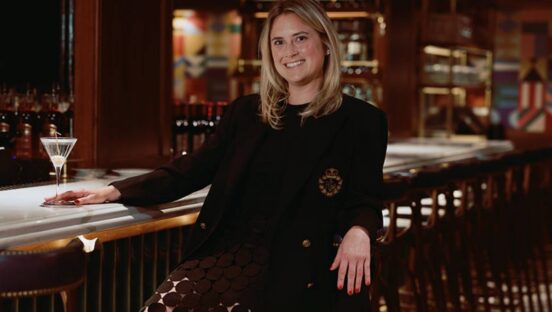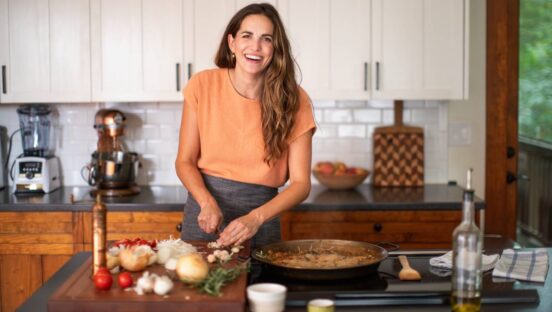

Not many chefs or restaurateurs can say they have a master’s degree in biomedical engineering, but Katie Button is one of them. She’s the cofounder and executive chef of the acclaimed restaurant Cúrate Bar de Tapas in Asheville, North Carolina, which is celebrating its 15th anniversary this year. She recently competed on CBS’s newest reality cooking competition show, America’s Culinary Cup, where she was among the final five contestants left. Plus, she’s preparing to release her second cookbook, Spanish Accent, this upcoming fall.
Button began her journey to culinary success as a PhD dropout. “I think it was probably my junior year of college that I should have started paying attention to how I was feeling about the classes I was taking and just not really having a vision for what I wanted to do next,” she recalls, but instead, she “just kept studying.” After earning chemical and biomolecular engineering degrees at Cornell, then receiving her master’s degree from Ecole Centrale, she was about to start a PhD program in neuroscience at the National Institutes of Health in Bethesda, Maryland, when she took a moment to step back and reevaluate. “It felt like, OK, this is now a decision for the rest of your life, and you better be all in on this. And if you’re not, it’s now or never to bail.”
“And so I did—I bailed,” Button admits. Her next step kickstarted what would become a wildly successful career as a chef and entrepreneur. “I knew I loved cooking. I had been cooking a lot in my spare time. My mother ran a catering business out of my childhood home, and food and cooking was such a big part of my life—I just had looked at it more as a hobby and something that kept me going than a career, but it definitely set the tone for me.”
- Most frequent emotion on America’s Culinary Cup? STRESS
- Kitchen tool you can’t live without? Microplane
- Most underrated ingredient? Anchovy paste
- Secret comfort food? Cheetos
- Best music to cook to? ‘90s Hip Hop
Button needed a job, and decided to apply to be a server at multiple establishments around town. “People were crumpling up my resume with zero restaurant experience, and throwing it in the wastebin left and right,” she says. Then, she walked into José Andrés’ Café Atlántico in Washington, D.C., where they gave her a quiz that tested not only her food knowledge, but also asked questions about her love and passion for food and hospitality. “They were the only ones who offered me a job, which was amazing,” Button laughs.
As soon as she started working at Café Atlántico, she knew she had “found the thing that really lights me up.” She was immediately thrust into the world of Spanish food and cooking, which would become the building blocks someday for her own Spanish tapas concept. Café Atlántico was also where she met her future business partner, Felix Meana, who became her husband, then ex-husband. “We’re best friends, and we’re still great business partners, and he’s also the father of my kids. So we are intertwined for life,” she explains.
Meana hails from Spain, and had worked at El Bulli—a legendary three-Michelin-star restaurant in Roses, Spain, managed by chef Ferran Adrià and brother Albert “that changed the way the world thought about food,” Button says on her website. “Through Felix, I found my way to Spain, and eventually into El Bulli’s kitchen myself in 2009, cooking alongside Ferran Adrià. It was the kind of experience that rewires you.”
Button found her worlds colliding while working at El Bulli, “which was literally where science and food come together.” Operating until 2011, the restaurant was widely recognized for pioneering techniques like spherification, foams, and liquid nitrogen cooking. That opportunity and learning environment felt serendipitous to Button, given her science background. “That became my way into the kitchen, was through the kind of world of molecular gastronomy where science meets food, which gave me a little bit of a leg up at the time,” she explains.
In 2011, Meana and Button—with the additional help of her parents—opened Cúrate Bar de Tapas in downtown Asheville, North Carolina, inside an old bus depot. The name means “cure yourself”—fitting for a town that’s always drawn people looking for something restorative, Button notes. They wanted to offer honest, soulful Spanish food that honors the hospitality customs and traditions in Spain while building lasting relationships with the farmers, makers, and Asheville community.
They picked Asheville because it’s a “magical place to live.” Set against the Blue Ridge Mountains and known for its vibrant arts scene and bustling downtown streets, the city’s quirky charm and stunning natural scenery draw nearly 14 million tourists every year. And with a rising restaurant scene, “Asheville was the choice” for their restaurant, Button emphasizes.
The concept also “had to be Spanish, because first of all, it had been the only food I had professionally cooked, which is just wild,” she says. “And also, he’s from Spain, and so he keeps me very honest on authenticity. And my kids are 50 percent Spanish. So Spain is my food love language, for sure.”
The menu at Cúrate is rooted in the lively tapas culture of Spain—inspired by its prized jamón Ibérico, vermuterías, and spirit of sobremesa—and guided by Spanish tradition and local Appalachian ingredients. The offerings range from classic small plates like patatas bravas, gambas al ajillo, tortilla Española, and seasonal croquetas to wood-oven dishes, paellas, Spanish charcuterie, and desserts such as Basque cheesecake and crema catalana. Altogether, the menu reflects Button’s commitment to genuine hospitality, high-quality ingredients, and a communal dining experience meant to bring people together.
In 2022, the James Beard Foundation honored Cúrate with its Outstanding Hospitality Award, and the restaurant was recognized in the 2025 Michelin Guide. Button has now been nominated for a James Beard Award five times, and in 2015, received the honor of being recognized as Food & Wine’s “Best New Chefs.”
Looking back, Button admits there were moments when she “doubted whether or not I could do it, for sure—just the long hours, the demand, the teaching and training of a team,” she says. “In the kitchen, you have to teach and train everyone how to do all of the things and stay on top of it and make sure it’s all being made properly. And when you’re starting up, it’s teaching everyone from nothing … It’s really, really difficult. And I think I would have just told myself to be patient, take some deep breaths, and focus on systems; systems make things easier.”
From writing out all the recipes for her dishes to creating charts and documents for inventory, Button found the more organized and structured she could be, the more efficiently she could run her restaurant and her team. “Our culture is a little bit about knowing exactly what you’re supposed to be doing and how to do it, and being given the tools that you need for that … coupled with this feeling of joy around shared dining experiences and hospitality and how to show up, not only for our guests, but also for each other in our workplaces,” she says.
By figuring out how to straddle these areas of structure, systems, and genuine care, Button has been able to engineer a kitchen culture marked by open communication and a commitment to continuous improvement. When problems arise—whether with service or staff—Button and her team assume a system or process is missing or broken, then focus on fixing it to prevent similar issues in the future. “It’s constantly about solving things so that the problem doesn’t happen again, and listening to people and understanding that we’re constantly striving to improve who we are and what we’re doing, both individually and personally, but also as a group together and a company and what we offer our guests,” she says.
That philosophy shows up tangibly in the restaurant’s all-hourly tip-sharing model, which pays everyone well above minimum wage and distributes tips transparently across front- and back-of-house (supported by tech such as 7shifts) so each role is recognized as equally essential to the guest experience. Over time, Button and her team have also built a robust benefits package including health, dental, and vision insurance, short-term disability, paid sick and vacation time, a 401(k), and a self-insured health plan paired with optional direct primary care memberships to make everyday and preventive care more accessible and affordable for staff.
Looking at broader cultural shifts and trends in the restaurant industry, Button has seen “a large shift in the focus and intention of how we take care of the people who work for us, and foster these cultures [where] the expectations are clear and fair—I think that that is where we are headed,” she adds.