
Artificial intelligence has entered the restaurant industry with plenty of promises, but there hasn’t been enough time to establish best practices for introducing this technology to the team in the field, let alone across multiple units. For operators, the most pressing question is whether their businesses are ready for the changes AI can provide.
Patrick Bobrukiewicz, vice president of AI strategy and innovation at Thrive Restaurant Group, says many restaurants are still trying to build the future on top of fragmented information. Even training materials, operating procedures, and brand standards are scattered in shared drives, PDFs, emails, or store-level documents. This disjointedness is a huge problem when it comes to using AI for efficiency, because AI can only be as useful as the information it can access.
“The majority of the data that we have in restaurants is really structured data,” Bobrukiewicz says. “Sales, labor, inventory, all of those things live in tables somewhere. The next step is getting it into a place where you can ask better questions.”
That shift, Bobrukiewicz believes, is where the industry is heading. Dashboards and reports are not going away, but he sees a future where operators spend less time hunting through them. Instead of pulling five reports to figure out what happened in a store, a manager could ask a system why labor ran high, why a menu item fell off, or whether a store is likely to run short on a key product before the weekend. This is a change with the potential for a real positive impact.
“A P&L is like reporting on the news the week after the weather is already done,” Bobrukiewicz says. “You’re sitting over here saying, ‘Hey, three weeks ago it was sunny.’ Great.”
The next phase, he says, is not about reporting the weather. It is giving operators a forecast.
At Thrive, that work includes using Google’s Gemini Enterprise to connect structured information with unstructured data. The goal is to start asking why things are happening and make adjustments from there. Bobrukiewicz describes the work through what he calls the “three threes”: get the data right, define the domain, and then create a discovery layer.
The first step is clean, accessible data. The second is teaching the system the language of the business. For example, a company may call its brick-and-mortar properties “units,” “restaurants,” “stores,” or “locations,” and the tool needs to recognize those nuances. Executive leaders may be called area directors, district managers, or something else entirely. If the AI does not understand those terms, the answers will feel off to the people who need to trust them. Only after those first two steps are completed should operators start building dashboards or internal chatbots.
“Most people want to jump immediately to the discovery layer,” Bobrukiewicz says. “They’re going to say, ‘Oh look, I’ve got the data. Let me build a dashboard. Let me build a report.’”
That approach can backfire. If a manager gets a bad answer once, or even an answer that feels disconnected from how the restaurant actually runs, the tool risks losing credibility with the team. “If they don’t trust that it’s right, they’ll put it down, and they just won’t use it again,” Bobrukiewicz says.
Before restaurants can reach the AI piece, many still need to confront data ownership. Bobrukiewicz says operators should pay close attention to whether vendors allow them to access and export their own information.
“Getting your paws on the data is usually the very first hurdle that we come up with in our industry,” Bobrukiewicz says. “We talk a lot about owning our own data, but then we will sign contracts left and right with vendors who won’t give us data. Don’t sign the contracts.”
That advice is becoming increasingly urgent as AI moves from curiosity-driven use to operational applications. If a restaurant group cannot connect its data, it will struggle to use AI for anything more than surface-level tasks. Operators with cleaner systems and stronger vendor agreements will have a better chance of turning AI into something useful in the long term.
Bobrukiewicz sees that practicality first shows up in the daily decisions managers already make. An AI-powered system may alert a store that it is trending toward a labor miss before the end of the day. It could flag that one restaurant is about to run out of a product while another nearby unit has excess inventory. It could help the executive team see patterns without waiting for a weekly report. That same thinking applies to kitchen display system (KDS) technology.
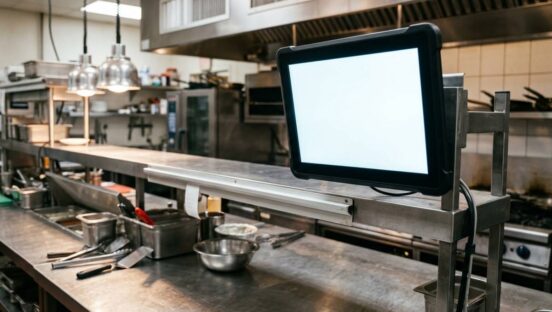
“KDS for me is a really easy sell,” Bobrukiewicz says. “Do you want your cold food cold, and do you want your hot food hot? If your answer to that is yes, insert KDS.”
A strong KDS can manage timing across stations, stage items that cook at different speeds, and separate dine-in orders from off-premise traffic. It can also show where service slows down. A paper ticket cannot tell an operator whether the problem was expo, the line, or a backed-up grill, but a KDS can. As restaurants continue to grow their online ordering and add more complexity to their menu, having a granular view of what’s happening is vital.
Marketing is moving in the same direction. We’re seeing Google Business Profiles as one of the most important assets for restaurants in response to changes in how guests search online. Consumers have transitioned away from simple queries to more specific prompts. As an example, instead of asking Google for “Mediterranean restaurants near me,” a diner may ask for “a dog-friendly dinner spot with gluten-free options, outdoor seating, Mediterranean cuisine with four-star reviews or above in a five-mile radius.” Restaurants that keep their hours, photos, menu attributes, and review responses up to date, with keywords when applicable, will have more success showing up as a suggested spot than businesses that don’t.
AI has also advanced A/B testing of creative assets across diverse platforms, suggesting variations and showing how certain types might perform. This frees up time for marketers to focus more on strategy instead of spending hours manually testing every component of a campaign.
For Bobrukiewicz, giving workers back their time is the larger promise of AI in this industry. The technology should not pull managers deeper into the back office. It should give them cleaner answers so they can spend more time training employees, serving guests, and getting results.
“It’s the art of the possible; it truly is,” Bobrukiewicz says. “We’re the ones helping to program the Iron Man suit. Let’s take this opportunity to use AI, to take our humans and let them do what humans do best: [Be] human.”