
Red Robin is starting to see traffic momentum, a metric that’s eluded the casual-dining chain for years.
Same-store sales increased 1.3 percent in the second quarter, with traffic essentially flat at negative 0.2 percent. That marked Red Robin’s best traffic performance since the first quarter of 2023 and beat the industry by 40 basis points, according to Black Box. The 465-unit chain also gained 80 basis points of visit share in trade areas where competitors operate.
More encouraging for the company was how the quarter finished. Traffic turned positive during Red Robin’s final period of Q2, and CFO Mark Graff said the company believes it can carry stronger traffic trends into the second half of 2026.
The improvement provides another checkpoint for the First Choice plan, the turnaround strategy CEO David Pace has spent the past year putting into motion. Its priorities span restaurant operations, traffic, the balance sheet, restaurant upgrades, and employees.
The traffic piece starts with value.
Red Robin’s Big Yummm platform continues to attract guests after launching last year, giving customers access to a burger, Bottomless side, and Bottomless beverage. Its impact has been particularly strong at lunch.
The chain has resisted using large price increases to offset pressure elsewhere. Average check increased 1.5 percent during Q2, consisting of 3.3 percent pricing offset by a 1.8 percent decrease from mix and discounts, largely tied to Big Yummm. It marked the fourth consecutive quarter in which Red Robin’s average check increase trailed the industry.
“Our objective is to generate traffic through attractive platforms rather than depend on broad-based discounting,” Pace said during Red Robin’s Q2 earnings call.
Red Robin is now applying that strategy to a daypart where it sees additional opportunity. Its Dinner Double Feature specifically targets dine-in dinner traffic, where gains have trailed lunch.
The offer gives guests a choice of select entrées paired with an appetizer, attempting to close the gap without extending a single value proposition across every occasion.
“The Big Yummm has had a great effect on the business, but it’s been skewed toward the lunch business and our lunch business has accelerated pretty aggressively, not as much on the dinner business, although the slope is the same. And I think we think there’s an opportunity to further close that traffic gap with a targeted offer at the dinner dining business,” Pace said.
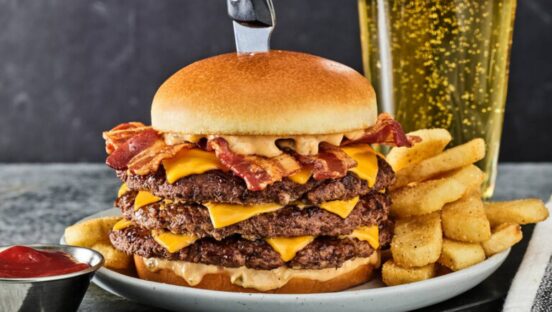
Menu innovation is adding another sales lever. Red Robin introduced Towering Double Cheeseburger Sliders during Q2 and expanded its bone-in wings into 8-, 12-, and 16-count options. The company also became the first national restaurant chain to carry Garage Beer, the brand owned by Jason and Travis Kelce.
Pace said the sliders drew significant customer feedback, giving the company confidence that it can create products capable of attracting attention instead of depending solely on value. More menu launches are planned for later this year and into 2027.
That combination of traffic and operational improvements is also translating to restaurant profitability.
Restaurant-level operating margin increased 20 basis points to 14.7 percent, Red Robin’s best second-quarter result in four years. Labor initiatives contributed roughly 50 basis points of year-over-year savings.
Red Robin has tied some of those improvements to its managing partner model, which gives restaurant operators a direct financial stake in the performance of their locations. Employee stability is helping, too. Hourly and restaurant-level turnover are at historically low levels, and employee engagement scores are running above industry benchmarks.
Technology has become part of that effort. Red Robin rolled out an enterprise version of ChatGPT across the organization last fall, and restaurant managing partners are using the system for labor scheduling, food-cost oversight, and guest-service decisions.
Physical technology inside restaurants is also getting attention. The chain is replacing server handhelds and plans to introduce upgraded Ziosk tabletop devices. Seven St. Louis restaurants recently received light-touch remodels as part of the company’s 2026 refresh program.
Red Robin wants those investments to improve order accuracy, efficiency, and speed without requiring the capital associated with extensive remodels.
The operational gains come as Red Robin prepares for a substantial change in the composition of its restaurant portfolio.
The company has signed three refranchising agreements covering 116 restaurants. Op Burgers is acquiring 69 locations across eight states, Evergreen Dining is taking 30 restaurants in Washington and western Idaho, and Kuber Dining is acquiring 17 restaurants in Oregon and Washington.
The transactions are expected to produce roughly $96 million in gross proceeds, which Red Robin plans to use to reduce debt and strengthen its balance sheet.
The company is also working toward refinancing existing debt that comes current later this year. Pace said Red Robin is already discussing options with bankers and expects it can secure better terms than its current financing.
Red Robin isn’t rushing into another round of refranchising, despite interest from prospective operators. Its immediate priority is completing the three signed transactions and transferring restaurants successfully.
“Our focus is on making sure we do these right. So our teams are engaged right now, both getting to the finish line on closing the transactions and then setting up the transitions with the new partners so that we can kind of have as much of a seamless handoff as we can,” Pace said.
The company maintained its full-year guidance following Q2. Red Robin expects comps growth of 0.5 percent to 1.5 percent, excluding deferred loyalty revenue, restaurant-level operating margin near 13 percent, adjusted EBITDA between $70 million and $73 million, and capital expenditures of $25 million to $30 million. The forecast does not account for the refranchising transactions.
Total Q2 revenue declined $6.1 million year over year to $278 million, primarily because of restaurant closures. Adjusted EBITDA fell $3.5 million to $18.9 million, driven largely by an additional $4 million in marketing spending compared with last year.
That marketing investment is part of Red Robin’s effort to make its traffic improvement durable. The company has moved toward more personalized and locally targeted messaging and believes those capabilities contributed to Q2’s trajectory.
The second half will provide a different test as Red Robin begins lapping the Big Yummm launch. Graff expects some of the mix pressure associated with the platform to ease, and the company sees an opportunity for traffic to strengthen from first-half levels. Pace said Q4 is expected to outperform Q3.
Red Robin also enters that period with more promotional and product tools than it had a year ago. Pace sees the ability to target specific occasions—such as dinner—alongside a pipeline of new products as evidence that the chain doesn’t need one initiative to carry its recovery.
“Some things work better than others as we’ve moved through the year, but we feel like the brand is now able to innovate, introduce ideas that capture the guests’ attention,” Pace said. “I mean, the slider stuff was really unique. We got a lot of commentary back about that. And we’ve got other things planned as we exit the year and we head into 2027. So I think we’re feeling pretty good about the pipeline that we’ve got.”